Kaufmann/Bononno,
Guy Debord
It's true that détournement is also based on a technique of dissimulation, if we insist on using the term, even though it would be more correct to speak of it as a ruse or feint. But it is at the very least problematic to attribute such a technique to the practice—considered shameful or inadmissable— of autobiography, a larvatus prodeo to which no more than a handful of self-proclaimed scholars hold the key. Reading Debord is not like a game of Trivial Pursuit, and I doubt that he was the least bit ashamed of his image or self-portraits. The concept of détournement entails the notion of detour, the intent to circumvent an obstacle, and contains elements of game playing and warfare. Détournement turns the reader or public into a warrior. It incorporates a strategy of blurring appearances, the rejection of comparative quotation demanded by the spectacle, which is currently so intrigued by the cliché of authenticity. Consequently, it also involves a rejection of an entire order of discourse, a logic of allocation, of pigeonholing, of signatures and responsibility through which everyone is in some way put back in his place or finds himself back there. But Debord, the lost child, did everything he could to avoid discovery, to not remain in his place. The spectacle has made authenticity a cliché we are assigned to, it continuously demands that we signal our presence. It is this imperative that détournement rebuffs; it is also, and perhaps especially, a technique of appropriation (which has never concealed its intentions), a technique for making the best possible use of words and texts. "Plagiarism implies progress," wrote Ducasse, it's least improbable inventor, a man Debord deeply admired. With détournement the cliché is taken over for special purposes, as were the Sorbonne much later and, more ephemerally, the Odéon Theater and a handful of factories. There was jubilation rather than dissimulation, none of the sorrow associated with hidden mastery. A challenge was launched against the cliché by a singularity whose self-rediscovery involved abandoning the cliché and reappropriating the belle langue of the century, as Baudelaire—here appropriated—had wanted to do. And Baudelaire, like Debord, was horrified by philanthropic journalists short on inspiration, who wanted to be considered equals or even friends. Charity leads to the spectacle, religiosity to the religious. (37)
dissimulate (v.)—"to hide under a false appearance"
(merriam-webster.com)
larvatus prodeo—something about a mask (The Internet)
feint — (n.) "a deceptive or pretended blow, thrust, or other movement, especially in boxing or fencing" (Google)
So, for VK it is "more correct" (37) to speak of détournement specifically as a tactical maneuver in a physical confrontation ("feint"), or as a "ruse," which seems not all that different from a "dissimulation." One can only hope that something was lost in translation here, because the difference seems stylistic rather than substantive. And the concept further "entails the notion of the detour, the intent to circumvent an obstacle" (37), from which it follows that the nature of the obstacle in question and one's reasons for attempting circumvention are factors which ineluctably color any potential judgment of the maneuver. In this case the obstacle is "comparative quotation [as] demanded by the spectacle," the "cliché of authenticity," "allocation," "pigeonholing," "signatures and responsibility" (37); in short, the way the spectacle "continuously demands that we signal our presence." (38) Fair enough as a goal, I think, but appropriating existing material seems at best a curious means, at worst an impotent one. Can one's location/presence not be triangulated perfectly well (or well enough) from a series of appropriative maneuvers as from ostensibly original ones? Certainly for me coming to this oeuvre without much of any common background with Debord et al, the attributed references are jarring enough on account of this dynamic as to constantly remind me of the author's presence in a different time and place, while the unattributed passages may as well not be appropriations at all since I'll never catch them. Which is to say that Debord, like most authors who for whatever reason continue to command our attention, is no more or less formed/defined/limited by the unique profile of his intellectual pedigree. That this dynamic is through appropriation manifested as a sort of jigsaw puzzle rather than as a tapestry of Influences is rather meaningless vis-a-vis tactical combat with the spectacle, to which both modus operandi signal one's proverbial presence perfectly adequately. Failing that line of reasoning being convincing, it is a simpler route perhaps to point out that Debord signed plenty of his works with his own name, and that unsigned or pseudonymous works, as VK occasionally chronicles below, while certainly part of Debord's toolkit were the exception rather than the rule.
As for "making the best possible use of words and texts" (38), this is segued into rather facilely as if it were an obvious implication of the above, but I would insist that as a question of valuation (comparative!) it is certainly not so simple. At best this position hews to one far-off endpoint of a continuum, at the other end of which lies the whole-cloth ideal which is responsible for supplying the plagiarist's ammunition in the first place. i.e. There is nothing to plagiarize (or nothing fresh and unspoiled) without the products of the whole cloth conceit, and similarly no getting off the ground for practitioners of this conceit without first making a certain peace with the inevitability of influence and the fact of its multiple pathways to manifestation. This much is noncontroversial; but to posit appropriation as the search for an
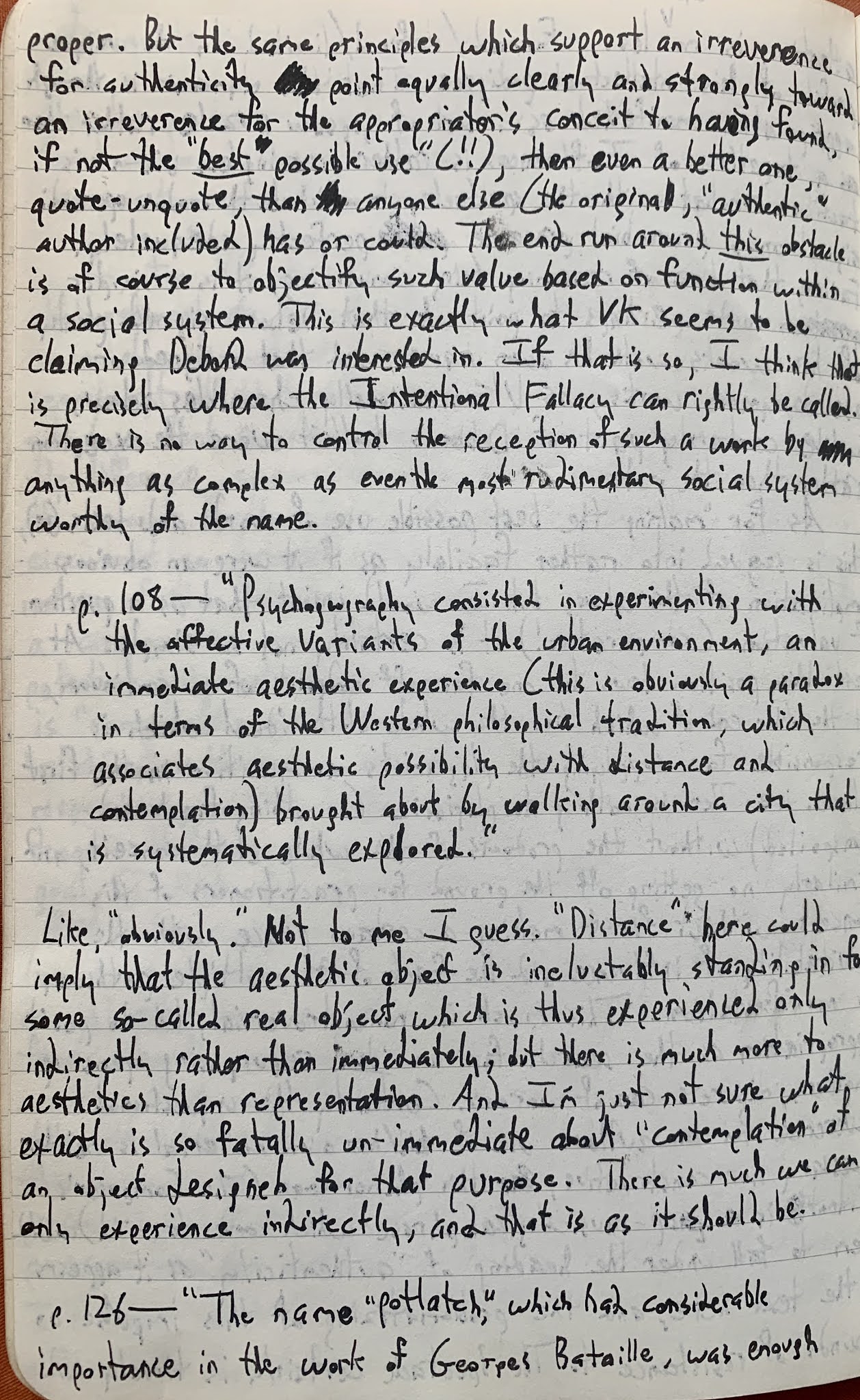
ideal repurposing opens up another, discrete can of worms. Certainly the unquestioned reverence for an author's use of his/her own material is neither necessary nor constructive; this phenomenon (The Composer's Intent is a pop-musicological phrase which comes to mind) would seem to fall under the heading of "authenticity" as it appears in the text here, and the problematizing of this impulse on grounds of resistance to The Spectacle certainly is timely and proper. But the same principles which support an irreverence for authenticity point equally clearly and strongly toward an irreverence for the appropriator's conceit to having found, if not the "
best possible use" (!!), then even a better one, quote-unquote, than anyone else (the original, "authentic" author included) has or could. The end run around
this obstacle is of course to objectify such value based on function within a social system. This is exactly what VK seems to be claiming Debord was interested in. If that is so, I think that is precisely where the Intentional Fallacy can rightly be called. There is no way to control the reception of such a work by anything as complex as even the most rudimentary social system worthy of the name.
[from a notebook, 2017]