Showing posts with label from a postit. Show all posts

24 May 2021

Boorstin—On Seeing and Not Being Seen

Daniel Boorstin
The Image: A Guide to Pseudo-Events in America (1961)

[My notes say:]

p. 231—"We wish our membership to be reported. We do not care to participate."

This is a very astute observation of how the Image-nonculture bleeds from top-down institutional levels to stain even individual social relationships, at which point it is equipped to become self-perpetuating. The examples of churches and service clubs are also well-chosen since this particular Image is very much bound up with the "democratic-humanitarian" impulse (127).

Then again, ITEA et al have made a stunning reverse achievement: we DO wish to participate (i.e. so we can promote ourselves) but DO NOT wish for this to be known by all of our peers elsewhere!

[from a post-it, 2017]

Boorstin—Look In The Mirror

Daniel Boorstin
The Image: A Guide to Pseudo-Events in America (1961)

[My notes say:]

p. 194—"...a vague but attractive image he has of himself."
THIS is a legit example of technology-driven change in society and culture: the sheer growth in ease and frequency of seeing oneself (or if you insist one's own Image) cannot have had less than a total impact on questions of self-image; an environmental change in human development whereby many people remain veritably arrested in Lacan's mirror stage, and are seemingly quite content to be so. Of course I also find the technology useful; it is here to stay in any case. But in that respect, Debord is correct that a "new way of living" is necessary, one which accounts for this question as one of human development.

[from a post-it, 2017]
[The passage:]
It [the image] must be a receptacle for the wishes of different people. Seldom is this so plainly acknowledged as in the recent program by Pincus Brothers Maxwell, clothing manufacturers of Philadelphia. They advertise their new brand of men's suits, not by a sharply focused photograph, but by a blur standing on the street. "The agency, Zlowe Co., New York," Printers' Ink explained (January 20, 1961), "came up with a campaign that discards the fashion plate for personal image. Based on deliberately blurred reflection photography, the illustration is supposed to sell the man through a vague but attractive image he has of himself."

Boorstin—Recordings as Pseudo-Events

Daniel Boorstin
The Image: A Guide to Pseudo-Events in America (1961)

[My notes say:]

p. 174—the recording as itself a pseudo-event
This is actually quite provocative, and I'm inclined to agree, at least in the metaphysical sense, not necessarily in the material/functional sense. Generally commercial sound recordings are not quite as central to the Dark Forces of image-mongering as scholars of music (for their own self-importance mostly) would like to think.

Having said that, the sonic wallpaper phenomenon (p. 175) IS real, it has since taken some yet more disturbing (and very functional) turns, and certainly in that metaphysical way referenced above it is nothing less than an affront to our humanity.

[from a post-it, 2017]

Boorstin—The Company We Keep

Daniel Boorstin
The Image: A Guide to Pseudo-Events in America (1961)

[My notes say:]

p. 170—"Have you seen my snapshot of the Mona Lisa?"
This point hits the mark but is, let's say, undertheorized here.
p. 171—"We are quite precise when we describe him as a devotee of hi-fi rather than of music."
Also a direct hit, and also undertheorized, though here of course I'm happy enough that he leaves the fleshing out to specialists.
In both cases, the first further order of business is this: the relationship between original and copy, artist and curator, is not symbiotic but in fact parasitic, and this is evidenced by which variable in the equation of valuation must be manipulated in order to change the output on the other side of the equals sign.

[from a post-it, 2017]

Boorstin—Museums and Contexts

Daniel Boorstin
The Image: A Guide to Pseudo-Events in America (1961)

[My notes say:]

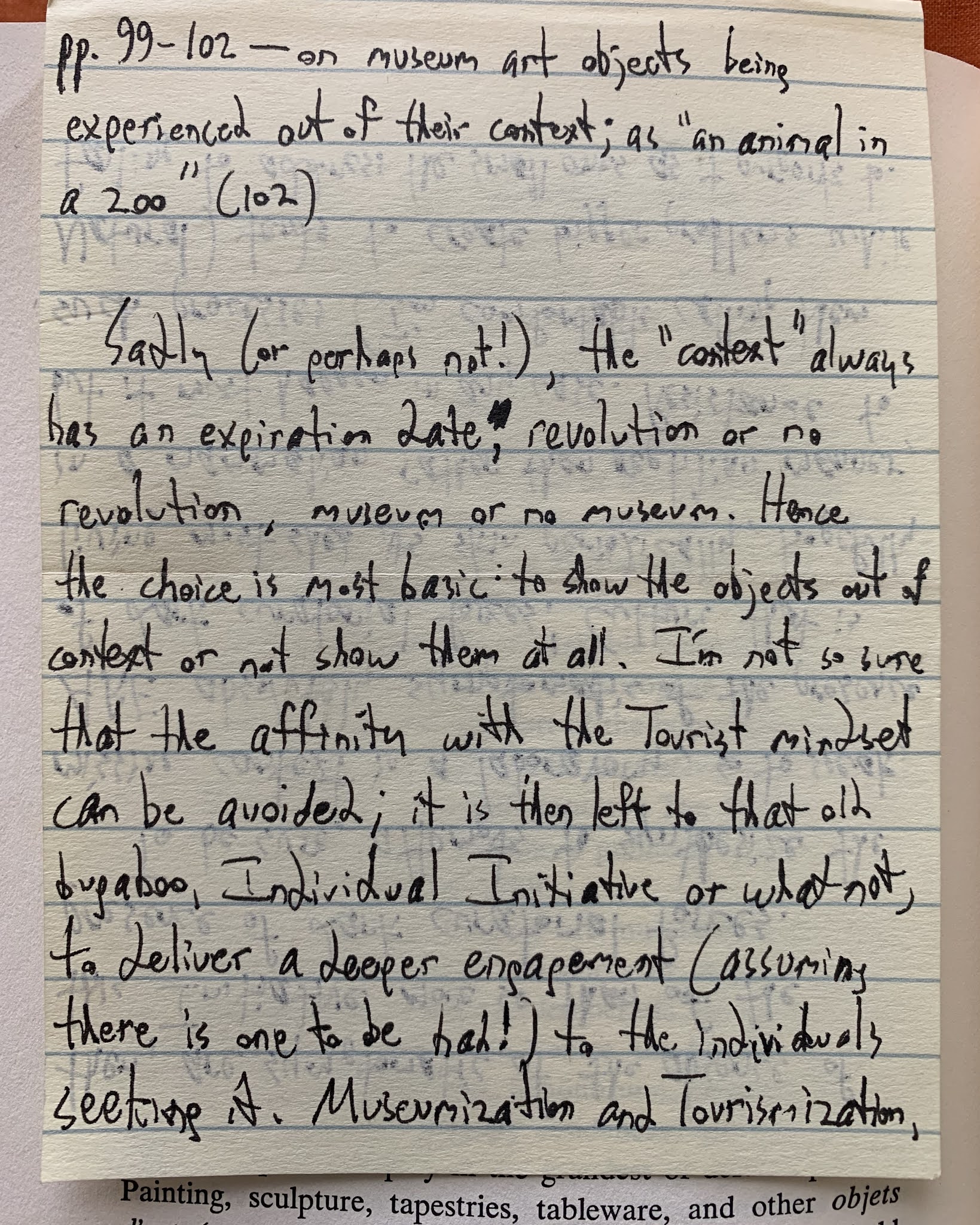
pp. 99-102—on museum art objects being experienced out of their context; as "an animal in a zoo" (102)

Sadly (or perhaps not!), the "context" always has an expiration date, revolution or no revolution, museum or no museum. Hence the choice is most basic: to show the objects out of context or not show them at all. I'm not so sure that the affinity with the Tourist mindset can be avoided; it is then left to that old bugaboo, Individual Initiative or what not, to deliver a deeper engagement (assuming there is one to be had!) to the individuals seeking it. Museumization and Tourismization, then, are symptomatic of the absence of this Initiative more so than of the presence of dark curatorial forces.

To be sure, attempts to synthesize the missing context in a laboratory, so to speak, ARE absolutely symptomatic of the presence of dark curatorial forces! Culture that is living must shed its skin periodically, hopefully in a mammalian rather than reptilian manner, but it must happen in any case. Resistance to such processes (I'm comfortable calling them Natural) tends to create bigger problems while failing to address the small ones as it purports to.

[from a post-it, 2017]

Boorstin—Immediacy as a Form-Content Issue

Daniel Boorstin
The Image: A Guide to Pseudo-Events in America (1961)

Readers and viewers would soon prefer the vividness of the account...to the spontaneity of what was recounted. (14)
[My notes say:]

A classic mapping of the Form-Content problem onto the Seriousness-Accessibility problem; which is to say that both Form and Content so construed do not mediate accessibility with equal force or aplomb; rather, Form is the gatekeeper, with all of the stigma (I would say of course) of that word as we use it to apply to middlemen in the social world of the arts. Of course the market/commodification is the real driving force toward an imbalance; but the dynamic is there in any case, market or not.

23 May 2021

Lipstick Traces—Attention-Seeking Ain't Easy

Greil Marcus
Lipstick Traces: A Secret History of the Twentieth Century (1989)

[My notes say:]

pp. 251-252—On Isou's "way[s] of getting attention" (252), incl. fabricating interviews with "luminaries of literary Paris" and titling a publication The Lettrist Dictatorship at a time (1946) when new details of Nazi atrocities were emerging daily.

This certainly could be seen as "worse than the punk celebration of the swastika," and certainly it "worked on the same levels," but more to the point, it probably wouldn't succeed in grabbing attention today, nor would the "placing" of fake interviews. And so there is one point of historical affinity here between then and now (there were and are at least some artists willing to lower themselves to this level in hopes of gaining exposure) and also one disaffinity (there are undoubtedly more of them now, both in absolute number and proportionately, and this cannot be due solely to extra-artworld dynamics but must, IMHO, be in at least small part an inevitable escalation generation by generation).

See also p. 323, final ¶ re: dedication of a film to the masters, "thus placing himself in their company." Is this not always the case with tributes?

[from a post-it, 2017]

Lipstick Traces—Mass Culture's Pop Heart Is Late To The Party...Again

Greil Marcus
Lipstick Traces: A Secret History of the Twentieth Century (1989)

[My notes say:]

pp. 70-73—on the explicit drawing of parallels between Punk and the Frankfurt School
p. 70—"The inane radio jingle you heard too many times a day fed into a totality: to get that jingle off the air, you somehow understood, the radio had to be changed, which meant that society had to be changed."

This "you somehow understood"...how isn't terribly important, unless it is. For me individually this was a (rare) textbook case of maturity interacting with experience; for a larger group of people not understandable as a monolith in either respect (or were they?) it's hard for me to imagine exactly what must/might have been In The Air the moment this totalism was realized as mass consciousness. Which is to say, I wonder if the totalistic thinking actually came first, arising from general (and legitimate) discontent but also being truly ignited by genuinely puerile and anti-social tendencies which are in no way either unique or interesting. Certainly these tendencies will tend towards the Total, and that is not a strength but a weakness, i.e. because this becomes, let's say, a very clumsy (if not bedridden) vehicle of both theory and praxis. It has no nuance or flexibility. And of course everything IS connected, but the connections themselves can be quite varied.

[from a post-it, 2017]

[A second such note:]

p. 70—"...now the premises of the old critique were exploding out of a spot no one in the Frankfurt School...had ever recognized: mass culture's pop cult heart."

Great news as far as it goes. But as for "positing punk music as a transhistorical phenomenon" (paraphrasing a passage from GM's Wikipedia page), the question remains of where/how/why this Critique does and does not bubble up; why it is, say, not always, and not never, but rather Transhistorical, ebbing and flowing. Hence as the punks were getting woke, others were dozing; and now that yet further groups of woke people are coming and going, Punk has passed into History, and a real live Punk is a sight to be pitied at least as much as respected. Hence the Transhistorical encompasses much that is in fact merely ephemeral; much that never Gets Over The Hump; much which cannot manifest and pass gloriously into history because no one person or demographic or occupational group can be counted upon once they're Woke to stay that way. So, uh...were the Frankfurt School ahead of their time, or the Punks behind theirs?

Lipstick Traces—Automatic Writing Is Still Monotonous, After All These Years

Greil Marcus
Lipstick Traces: A Secret History of the Twentieth Century (1989)

[My notes say:]

pp. 64-65—on what elsewhere gets placed under the heading The Democratization of Creativity

All of this being as it is vis-a-vis "You don't need nothin'. Just play it", it's worth recalling that the Situationists had quite early in their history realized that "We now know that automatic writing is monotonous." It should not have been difficult to see the analogous aspects of unrefined musical technique, especially not since that was well-known by this time in a couple of contemporaneous musical milieux. With THAT context front and center, the explosion of activity recounted so fondly here is much more lucidly viewed as the negative reflection of these people's prior ignorance rather than any kind of blossoming; and if the activity undoubtedly had value for them as individuals to achieve the feeling, if not the state, of agency/empowerment, one imagines that such individual afterglow was easily and precipitously shattered by the eventual realization that so many other musically unrefined individuals could and did do exactly the same things with their newfound agency. I think it is demonstrable that refinement per se was of less interest to the Situationists than was, say, functionalism (e.g. in architecture), ahistoricism/timelessness, etc. Those issues are not directly addressed by the punk aesthetic, as best I can tell from this account; refinement per se is not necessarily related.

[from a post-it, 2017]


[Now:] The Goodreads reviews of this book are vicious and seem to hit the mark. And so here I come, giving it attention it probably doesn't deserve. Ignoring it might be more appropriate. But indulge me here as you might indulge any unrefined technician searching for a sound.

Rereading these pages now, two stickier webs of intrigue leap off the page. First: "A lot of people...didn't think this was music at all, or even rock 'n' roll; a smaller number of people thought it was the most exciting thing they'd ever heard." (64) Great. Just like literally every other new style of music ever. But sure, let's then quote someone who is (1) part of the "smaller number" rather than the bigger one, and (2) famous; then we'll have them yatter about how great it all was; finally, the coup de grace, to make the implicit explicit, (3) we posit this famous person to be representative of all the little people you'll never meet and need not give a shit about: "what Westerberg said, so said countless other people." Sure. History is necessarily reductive, space is limited, etc. But only a broad and, ultimately, superfluous thesis has been thus reduced; Westerberg's own words, meanwhile, occupy quite a chunk of the page in full granular detail and thereby betray elements of his perspective which cannot possibly qualify him as speaking for "countless" others. Historical reductionism is one thing; but here we have, in tandem, an expansion of the personal, an arbitrary diversion which goes on for way too long, and which from a macro perspective thus works rather directly against the reductionist's conceit to authority. What gives? I think there is a sort of currency trading that art and music critics love to transact, whereby a dollar's worth of fame is thought to buy many shilling's worth of representativeness. I have been collecting examples of this. This one is not the worst of them, but it does exemplify the maneuver quite transparently. I gotta think it ain't very punk! So, for those who do think that "criticism" per se has any reason at all to still exist and to be taken seriously by anyone for any reason, I double dog dare you to do "criticism" without doing this. Just once. Please.

Second, "They made a blind bet that someone might be interested in what they sounded like or what they had to say, that they themselves might be interested." (65) Awesome. Regular readers know that I struggle to find the balance between acknowledging my own privilege and making honest sense of things other people say. This "blind bet" remains a crucial aspect of life. Everyone needs to give it a shot! For their own sake, that is. But let's also keep sight of all that has changed since this book was published. When everyone takes their shot, the effect on culture is now somewhat like the effect on the power grid when everyone turns on their air conditioners at the same time. The options at that point are few and they are not good ones: barricade oneself in some form of artificially constructed isolation or small community; or fight for negligibly small, temporary pieces of recognition on the present "mass" level. It's fun to place the bet, but it almost never hits anymore, and when the bet doesn't hit, it can literally kill people from the inside and/or lead them to hysterically kill other people on the outside. Cruelly, in the "long tail" paradigm of cultural consumption, recognition has been capped at an upper limit even for the high rollers, rather than being truly "democratized" or expanded to include everyone whose "blind bets" deserve, cosmically at least, a modest payout. As creativity has been "democratized," recognition has become scarcer. So, uh...are we sure it was their creativity that punks were reclaiming? Or is recognition per se always already at the table when we place our bets?

Now, in hindsight, it was possible to valorize the "blind bet" only because so few people had been making it, or perhaps because it was much more difficult than it is now to know how many people were making it and to what end. The more people who bet, the less valorous it becomes; to the point that nowadays I feel a twinge of guilt even about making a few extra off-the-cuff posts, like this one, which help me to meet my own needs of self-examination and arrogation-of-voice, but which cannot contribute much more than noise to the overall condition of humanity and certainly are quite unlikely (though I'll cop to holding out the same hope as you do!) to pay out much of anything in the recognition department, material or otherwise.

22 May 2021

Jappe—Debord—On Never Asking For Help

Anselm Jappe
Guy Debord (1993)
trans. Donald Nicholson-Smith (1999)
Debord claimed, and there is no reason to doubt him, that he never asked anything of anyone, that it was always others who approached him. (111)
Actually, this is not necessarily something to be proud of and could even conflict with the spirit (if not the letter) of Situationist theory given its grand practical pretensions and collectivist ideals. Perhaps this merely refers to the issue of "accommodation...with the system?"

[from a post-it, 2017 or 2018]

Jappe—Debord—Bursting the Third-Worldist Bubble

Anselm Jappe
Guy Debord (1993)
trans. Donald Nicholson-Smith (1999)
A bubble that the SI found easy to burst was the excessive enthusiasm for revolutionary movements in the Third World... The SI (like Socialisme ou Barbarie) believed that "the revolutionary project must be realized in the industrially advanced countries"... A bit of mockery of Third-Worldism is no doubt to be detected in the SI's use of such terms as "backward sector," "underdevelopment," and "war of liberation" in connection with the issue of everyday life. ...nor did "the young" per se, or the various "marginal" groups, inspire any confidence..." (97-98)
Really, this misplaced faith in the marginalized is quite a bit more (or, if you insist, less) than comfortable Westerners "striving to cover up their own ineffectuality." (97) That accusation smacks of personal score-settling at the expense of clear thinking. Rather, mustn't there be some species of White Guilt, or some similar organic psychosocial construct, motivating Westeners to offload both responsibility and valorization to the proverbial Third Worlders who have historically been on the wrong end of Western affluence? It seems like it must be a form of self-rejection, as we certainly see among Woke white people all the time in more local issues.

[from a post-it, 2017 or 2018]

Jappe—Debord—Unfulfilled Wishes

Anselm Jappe
Guy Debord (1993)
trans. Donald Nicholson-Smith (1999)
...the Situationist criticism of the work of art is curiously reminiscent of the psychoanalytical account, according to which such productions are the sublimation of unfulfilled wishes. For the Situationists, inasmuch as progress had removed all obstacles to the realization of desires, art had lost its function, which was in any case subordinate to desires themselves. (70)
This is a comparison I would not have thought to make, perhaps because psychoanalysis is calibrated toward individual psychology (note lower case) whereas the Situationists often spoke in the broadest (i.e. social/societal) terms. It is thus not clear to me that such a comparison achieves much besides highlighting a common concern with desire. It should therein be kept in mind that cultural production Beyond Necessity does not necessarily entail anything quite rising to the level of "desire" per se; also that it is not quite so easy to compartmentalize the Necessary and the Cultural: if food must be gathered no matter what, there will nonetheless be a different gait (dare I say aesthetic?) to each gatherer.

AJ appropriately labels this critique "debatable," which, channeling psychoanalysis again, is a cue to consider motive. If "the further culture advanced, the more doubt it was obliged to cast on its own social role," (70) then it is but a small step from there to a comprehensive value system (or Revolutionary Program, if you insist) which privileges not only the ultimate Revolution but also what can only be called a certain primitivism vis-a-vis culture prior to its later "advance."

[from a post-it, 2017 or 2018]

15 May 2021

today i found a tiny bit of courage floating in the cesspool of compulsory optimism that is our postmodern, postjudgmental world

Subjectivity as the Beginning of the End

Richard Gombin
The Origins of Modern Leftism (1971)
trans. Michael K. Perl (1975)
on the Situationists:

p. 72—"This incorporation of the subjective dimension in the revolutionary quest is a completely new phenomenon in the tradition of the labour movement...
...the struggle of the subjective broadens the front of the old class struggle. ...this notion [is] completely foreign to Marxism..."
It's worth pausing to consider the last bit, ca. 50 or so years on, in light of PoMo, Intersectionality, etc., where this point is acknowledged only to widely varying degrees. Also to reiterate a point which those movements make abundantly clear, and which the Situationists didn't always acknowledge: subjectivity is messy, infinite regress is the rule, and hence this veritably railroads movements into "total contestation," incremental/single-issue work being impossible this way.

[from a post-it, 2018]

The All-None Problem

Richard Gombin
The Origins of Modern Leftism (1971)
trans. Michael K. Perl (1975)
per H. Lefebvre:

pp. 70-71—"...before life can become the art of living, art has to invade life. ...artistic activity enables participation by the individual in the world: art has always been the highest form of creative work. The individual can only become liberated if art ceases to be a specialized activity, ceases to be, in its mercantile form, a reified activity. ...men will only be happy when they are all artists."
And yes, if they are all artists, then none of them are artists. Hence "supersession." Is there more? If we deconstruct the "mercantile form" of modern art just a bit, we in fact find quite a few artists (both pros and committed hobbyists) seeming/claiming to derive their specifically artistic brand of fulfillment either directly or, more often, indirectly (yet unmistakably) from the receipt of external validation via the reified form of practice/reception. It is "reified" per se specifically for creating an exchange value, which is the quantificational vehicle of this external validation. The all/none issue, trite as it may be, thus asks us to consider whether art is really "the highest form of creative work" or whether it is, rather, merely the most powerful differentiator among subjects, hence the most powerful ego stroker. The latter is certainly ripe for supersession, but I suspect the result to be None rather than All, and that sounds less like utopia than a different kind of pestilence.

[from a post-it, 2018]

12 May 2021

Collins and Bilge—(Young) Bolsheviks in the Bathroom

Intersectionality (2016)
Patricia Hill Collins and Sirma Bilge

p. 167—schools as "important venues for youth activism," because "that's where they spend their time"

Indeed, they presently spend virtually all of their time there, which forces the channelization of all kinds of impluses into the School life, most of them only rather uncomfortably. This takes the longer-standing suspicion of youthful rebellion by adults and adds the more basic grounds for skepticism that so much such rebellion is so obviously of limited scope. The element of sequestration is, if not more pressing than the issues raised by Freire, certainly more basic and expansive. That is to say that even with an ideal "critical" education, no student can possibly develop evenly if they are sequestered. This has nothing to do with school failing to reflect the Real World; school should not reflect the Real World quite so thoroughly, but nor should students be holed up in one airless corner of it to the extent that the discussion of youth activism necessitates accounting for the peculiar form of their location. It is an unfortunate (and one hopes unintended) consequence of the focus on expanding access that this side of the discussion is more or less beyond the pale for most of the Left. What are we expanding access to? The fact that student activism has a sociological literature devoted to it is one big cue to ask that question.

[from a post-it, late 2017]

Collins and Bilge—It Takes Skills and Time

Intersectionality (2016)
Patricia Hill Collins and Sirma Bilge

p. 116-123—on Hip Hop as youth culture

One point of affinity here with "the neoliberal status quo" (117) is this: art is worthy of mere mention only in the context of a (very questionable) theory of youth. Do any adults make Hip Hop?! Does their work aspire or achieve in simlar or different manners? Youth "rarely have the skills and time to get elected to public office" (117), but somehow these limitations are not only surmountable but in fact salutary to their making socially engaged art! This, then, if it is such a great situation, exemplifies art's place in society, namely as literally juvenile and stunted, the best among a few bad options for the unripe to be up-waivered to an adult level of agency without actually living the life of an agent.

Art being among the "areas" of which the authors "could not include an extensive discussion" (viii), this case study is implicitly asked to bear quite a bit more weight than it is able to.

[from a post-it, late 2017]

Collins and Bilge—Disciplinary Segregation

Intersectionality (2016)
Patricia Hill Collins and Sirma Bilge
p. 100—"Overall, the non-intersectional approach of each area limited its ability to consider the ways which other areas might shape its distinctive concerns."
My gut reaction to this paragraph was that it is too sweeping/total in its dissent. Upon a second reading, the word "limited" seems a satisfactory qualification. It is even so hard to believe that disciplinary "segregation" was ever fatal; more likely, I would think, the cross pollination, being of that inevitable/ineluctable type that we all love to invoke in situations like this, was, variously: unintentional, inexplicit, fluid, chaotic, ebbing/flowing, etc. If so, the contribution of Intersectional thinking vis-a-vis advancing said work to a more powerful, relevant, effectual place, would be selective and incremental rather than total and sweeping; and that matter bears as heavily on internal academic politics/legitimation/turf wars/etc. as it does on the Cause. Just saying.

[from a post-it, late 2017]

Collins and Bilge—Experience≠Evidence≠Theory

Intersectionality (2016)
Patricia Hill Collins and Sirma Bilge
p. 46—"...foregrounds the ways in which activism or experience shape knowledge, an insight that is often lost when theoretical approaches are institutionalized in the academy."
This is something of a false dichotomy, or at least a diversionary one. What both "experience" and "theory" suffer from, statistically speaking, is insufficient sample size. Hence the more technocratic, mainstream methodologies of Sociology proper typically involve a certain gathering of evidence before any conclusions are (or can be) drawn. It is true that this has historically been the site of myriad biases, usually toward Power and whatever groups hold it; but if that is so scary, just look at what an eerily similar conception of knowledge construction via "experience" currently prevails among the alt-right and the ways which it is called into service by them (e.g. D'Souza's "rational discrimination"). Can we really trust informal consortiums of like-minded activists to pool their experience and look for patterns with any meaningful degree of detachment? Probably no more than we can trust ivory tower theoreticians with no "experience" at all to create it in their proverbial laboratories. Scientific empiricism is hardly perfect, but IMHO it beats the pants off the other options, and I do find it conspicuous by its absence here.

[from a post-it, late 2017]

Collins and Bilge—The Applied Focus and Its Discontents

Intersectionality (2016)
Patricia Hill Collins and Sirma Bilge
p. 37—"To varying degrees, scholars and practitioners in social work, criminology, public health, law, and education recognize that knowledge production in their respective fields cannot be separated from professional practices. ... Because they straddle scholarship and practice, academic disciplines with a strong clinical or applied focus have been especially receptive to intersectional frameworks. Intersectionality often finds a welcome home in fields that already see theory and practice as interconnected."
The arts (or some version of them) would seem to merit passing mention here, but alas, another example of their failing to register. I tend to think that such conspicuous omissions are informative for artists.

As far as the internal dynamics of particular art practices, the relevance of intersectionality would seem to hinge on a given practice's relationship to notions like personal expression, telling your story, etc.

Certainly the arts also are, to varying degrees, "oriented to public engagement," but of course it is the basest form of this orientation (i.e. marketing) that brings consideration of identity most directly into the dialogue; and to be sure, much ostensibly charitable outreach work deserves to be categorized under the heading of marketing. The basic problem is that class remains a useful catchall vis-a-vis access to the arts, and in a way that the authors specifically deny is the case elsewhere.

[from a post-it, late 2017]