One more to plug, though there's no labyrinthine score to post this time: today at noon in the Main Gallery, I'll be performing with one of Larry Koonse's two Jazz Faculty Ensembles here at CalArts.
If you speak CalArtian, you know that the term "Jazz Faculty Ensemble" could be a bit misleading to non-initiates: it refers not to the perfunctory, under-rehearsed dog-and-pony show that most schools' faculty throw together more out of professional obligation than a desire to play together, but rather to instructor-led student groups where the faculty member in question performs with the group at all times. It's been a great experience, one of the specific reasons I sought out this school, and I don't know why more institutions don't run things this way. (Actually, I know exactly why and so do you, but let's just play nice for the moment.)
Having paid the school that single compliment, I'll now add that this first semester has been a real struggle overall, sometimes severely so. There's a lot going on here that simply doesn't make a whole lot of sense, administratively, aesthetically, and socially, and there's a general feeling among the students that we are overpaying for what we are getting. I want to leave it at that for the moment. Perhaps it will all come together next semester or next year, or maybe it has all come apart for good; I can't tell yet. I am at least aware of a smattering of special circumstances which converged this semester that are unlikely to align again while I'm here. Thus, a detailed, point-by-point takedown would be unwarranted and unfair to the many fabulous people I've been privileged to work with thus far. If you were expecting more at some point this Blog Month, I have to apologize and ask you to wait. Rest assured that you will understand this place when I do, and also that if you were looking to resolve seemingly contradictory rumors about it, you're safe in assuming that they are in fact all true.
14 December 2011
13 December 2011


12 December 2011


11 December 2011
Fakery
I'm beginning to wonder if a chart of our collective progress on the technological march towards virtual reality would actually resemble that of an oscillation (i.e. periods of success followed by periods of regression) rather than an exponential curve (i.e. continuous accelerating progress). I say this not because one could reasonably say that we've truly regressed technologically, but because of some recent experiences with fake reality that are more real but less useful (and perhaps more to the point for a musician/artist, less aesthetically pleasing) than the older, less real ones seem to me to be.
As a kid, I was not allowed to gorge myself on video games to the extent of many of my peers; my mother simply would not allow it. I did gorge myself on television, but still less than some. Even so, when today I happen by some bizarre turn of events to catch a glimpse of a cartoon or video game, I'm typically most surprised at (a) the turn towards realism, and (b) how profoundly aesthetically unsatisfying this is to me. It's an old man's gripe to be sure (I'm not yet 30, but in the technological world, that's middle age), and I've heard enough of them directly from old men to be wary of committing the same fallacies. My gut reaction is nonetheless remarkably consistent. Modernist though I claim to be, perhaps I'm finding for the first time some appreciation for the advice of so many conservative composition teachers that imposing limitations on one's process can be beneficial to the outcome. There are more than a few vinyl hoarders and NES players (and conservative composers) who would agree, no doubt cherrypicking their evidence with the utmost caution and backtracking appropriately when confronted about their iPhones.
The reason I bring this up here is that I'm coming to view notation software playback as one of these areas. When I upgraded to Sibelius 6 in 2009, I had been using version 2 since it first came out (yes, that's kind of a really long time). There was quite a bit to learn, a lot of useful new features, and a few real pissers. (The chord symbols! Barf...) The biggest challenge to this day, though, has been the built-in sounds. They are much more "realistic" sounds than the old general MIDI sounds I had become very accustomed to, by which of course I mean that it would now be much easier, possibly even a foregone conclusion, to identify by ear the instrument they purport to represent. (Forget the specific instrument; with the old sounds, you sometimes wondered which instrumental family was in play.) For whatever reason, though, I find them much more difficult to work with: the timbral whole is still less than the sum of its parts.
In some cases, notably the tuba, this is because they've essentially built mistakes into the samples:
Band Teacher Purgatory Sounds Like This
Yes, there's a better than average chance that your garden variety community band tuba player will wobble slightly on a low A before the pitch stabilizes, but seriously guys, let's just shoot for the stars next time and pretend that tubists are at least theoretically capable of emitting a steady tone for more than 2 beats at a time.In other cases, I undoubtedly struggle because I spent an incredibly long time working with the old general MIDI sounds and hence got very accustomed to interpreting them. Space, balance and blend have always been the achilles heels of notation software mockups of through-composed, acoustic music, and I don't think the present results are any more accurate despite representing an obvious attempt to improve in just these areas. I'm left to wonder if I am, in fact, just getting old, or if we had not actually stumbled on a semi-optimal degree of reality, unbelievable as that would have been at the time, in comparison to which the next rung of progress actually looks regressive. Perhaps a virtual reality that is obviously fake would be more useful here than one with loftier aspirations and spectacular failures.
As a kid, I was not allowed to gorge myself on video games to the extent of many of my peers; my mother simply would not allow it. I did gorge myself on television, but still less than some. Even so, when today I happen by some bizarre turn of events to catch a glimpse of a cartoon or video game, I'm typically most surprised at (a) the turn towards realism, and (b) how profoundly aesthetically unsatisfying this is to me. It's an old man's gripe to be sure (I'm not yet 30, but in the technological world, that's middle age), and I've heard enough of them directly from old men to be wary of committing the same fallacies. My gut reaction is nonetheless remarkably consistent. Modernist though I claim to be, perhaps I'm finding for the first time some appreciation for the advice of so many conservative composition teachers that imposing limitations on one's process can be beneficial to the outcome. There are more than a few vinyl hoarders and NES players (and conservative composers) who would agree, no doubt cherrypicking their evidence with the utmost caution and backtracking appropriately when confronted about their iPhones.
The reason I bring this up here is that I'm coming to view notation software playback as one of these areas. When I upgraded to Sibelius 6 in 2009, I had been using version 2 since it first came out (yes, that's kind of a really long time). There was quite a bit to learn, a lot of useful new features, and a few real pissers. (The chord symbols! Barf...) The biggest challenge to this day, though, has been the built-in sounds. They are much more "realistic" sounds than the old general MIDI sounds I had become very accustomed to, by which of course I mean that it would now be much easier, possibly even a foregone conclusion, to identify by ear the instrument they purport to represent. (Forget the specific instrument; with the old sounds, you sometimes wondered which instrumental family was in play.) For whatever reason, though, I find them much more difficult to work with: the timbral whole is still less than the sum of its parts.
In some cases, notably the tuba, this is because they've essentially built mistakes into the samples:
Yes, there's a better than average chance that your garden variety community band tuba player will wobble slightly on a low A before the pitch stabilizes, but seriously guys, let's just shoot for the stars next time and pretend that tubists are at least theoretically capable of emitting a steady tone for more than 2 beats at a time.In other cases, I undoubtedly struggle because I spent an incredibly long time working with the old general MIDI sounds and hence got very accustomed to interpreting them. Space, balance and blend have always been the achilles heels of notation software mockups of through-composed, acoustic music, and I don't think the present results are any more accurate despite representing an obvious attempt to improve in just these areas. I'm left to wonder if I am, in fact, just getting old, or if we had not actually stumbled on a semi-optimal degree of reality, unbelievable as that would have been at the time, in comparison to which the next rung of progress actually looks regressive. Perhaps a virtual reality that is obviously fake would be more useful here than one with loftier aspirations and spectacular failures.
10 December 2011
There's not even a sliver of enlightenment to be had in this space tonight other than what exceedingly little it might be worth for you to know that I have a potentially much more enlightening piece to share which I cannot properly complete without ftp access to my personal website, which some combination of the technological variables at play here simply will not allow at the moment.
In response to my bewilderment at the irreverence for attacks and releases in much live electronic performance, a more well-informed student posited that this merely points to a difference in formality between this musical world and the predominantly acoustic one I'm more accustomed to. I'm skeptical, but not because I want to be: it certainly would be comforting to find technology more consistently functioning properly where the operators are skilled and conscientious artists rather than standard issue IT grunts, but I'm afraid the results are remarkably similar most of the time.
In response to my bewilderment at the irreverence for attacks and releases in much live electronic performance, a more well-informed student posited that this merely points to a difference in formality between this musical world and the predominantly acoustic one I'm more accustomed to. I'm skeptical, but not because I want to be: it certainly would be comforting to find technology more consistently functioning properly where the operators are skilled and conscientious artists rather than standard issue IT grunts, but I'm afraid the results are remarkably similar most of the time.
09 December 2011

08 December 2011
Doublethink Invades The West
Does Capitalism (or what goes for it here in the USA) not demand/engender/impose much the same psychological condition as archetypal Orwellian totalitarianism does? So few of the people I meet who play our Capitalist economic game, musically or otherwise, seem the least bit sincere in either words or actions, and I think this goes beyond the simple fact that convincing someone to purchase something they previously did not intend to purchase requires...well, some convincing. More to the point: no child grows up dreaming of selling jewelry or vetting credit histories, nor do the ones who grow up dreaming to be musicians typically find fulfillment of those dreams playing wedding receptions or church services. It is on that most basic level that sincerity is rendered more or less untenable in our culture, including for those "doing what they love" in service of something or someone that they don't.
This is merely our minimum common inheritance; the insincerity can, of course, be much deeper as well. My time at the airport permanently changed my perspective on this: here you have two groups of citizens ("business travelers" and "security professionals") more or less involuntarily thrust into an acrimonious "us versus them" relationship by economic and social realities (not to mention some questionable reactions to them by our elected officials). No one at these checkpoints wants to be there: Traveling Salesman and Security Guard are not dream jobs. Their unique relationship, of course, is that this is primarily due to the specter of having to deal with the other group! Such it is that the airport security checkpoint became the "divide and conquer" mechanism par excellence as the Bushes simultaneously crashed the economy and began erecting a police state from scratch: throw the middle class out of work and let them choose between selling useless shit and enforcing useless rules, and not just to anyone, but to each other. No wonder sincerity is in such short supply.
The dynamic in the musical world is not quite so sinister, but nor should we simply accept it on account of music being, as I of course have argued with apologies to most of my dearest colleagues, a very sophisticated but ultimately trivial recreational activity. Issues of sincerity are never trivial, and the recreational value of music, if that is in fact its greatest value, suffers tremendously at the hands of the entrepreneurial spirit, dismembered as these hands too often are from their thinking, feeling body.
This is merely our minimum common inheritance; the insincerity can, of course, be much deeper as well. My time at the airport permanently changed my perspective on this: here you have two groups of citizens ("business travelers" and "security professionals") more or less involuntarily thrust into an acrimonious "us versus them" relationship by economic and social realities (not to mention some questionable reactions to them by our elected officials). No one at these checkpoints wants to be there: Traveling Salesman and Security Guard are not dream jobs. Their unique relationship, of course, is that this is primarily due to the specter of having to deal with the other group! Such it is that the airport security checkpoint became the "divide and conquer" mechanism par excellence as the Bushes simultaneously crashed the economy and began erecting a police state from scratch: throw the middle class out of work and let them choose between selling useless shit and enforcing useless rules, and not just to anyone, but to each other. No wonder sincerity is in such short supply.
The dynamic in the musical world is not quite so sinister, but nor should we simply accept it on account of music being, as I of course have argued with apologies to most of my dearest colleagues, a very sophisticated but ultimately trivial recreational activity. Issues of sincerity are never trivial, and the recreational value of music, if that is in fact its greatest value, suffers tremendously at the hands of the entrepreneurial spirit, dismembered as these hands too often are from their thinking, feeling body.
07 December 2011
BM4 Placeholder/"Is anybody actually reading this?" open thread #1
For the musicians reading:
What is your relationship with scores?
Does seeing the score tend to enhance or detract from your enjoyment of the piece in question?
What do you learn from score study that you cannot achieve by listening to recordings or live performances?
How well could you grasp your own scores if they were not yours and you could not hear them played?
How many scores that you have studied or just skimmed of your most favorite pieces would be dismissed sound unheard by most any present-day grant, admissions or programming committee because of the notation, formatting, and/or engraving?
To jump start discussion, I'll share my answer to the last one: "Most, if not all."
What is your relationship with scores?
Does seeing the score tend to enhance or detract from your enjoyment of the piece in question?
What do you learn from score study that you cannot achieve by listening to recordings or live performances?
How well could you grasp your own scores if they were not yours and you could not hear them played?
How many scores that you have studied or just skimmed of your most favorite pieces would be dismissed sound unheard by most any present-day grant, admissions or programming committee because of the notation, formatting, and/or engraving?
To jump start discussion, I'll share my answer to the last one: "Most, if not all."
06 December 2011
Distance as Illusion in György Ligeti’s Lontano
More than a mere “transitional” work, Lontano represents an arrival as well, at once an extension of and a departure from the music with which György Ligeti made his name. Lontano no less than the now-archetypal Atmosphères could legitimately be described as achieving a static quality, but these are two very different kinds of stasis. In the case of the former, as the title would suggest, distance is the operative principle, and therefore, one might infer, illusion as well. With increasing distance, large objects appear smaller, loud sounds softer, and bright light dimmer; this is the stasis of Lontano, a matter of perspective rather than an inherent quality of the object itself. Indeed, Ligeti’s communication of metaphorical distance through very real music which also stands exceptionally well on its own is masterful; yet in extending the metaphor a bit further, an important feature of this music is that the closer one gets to the object in question, the greater intensity it displays, thereby pointing to the illusion that distance has created before ultimately restoring it.
Ironically given this emphasis on distance, on a technical level, one might say that Lontano puts micropolyphony under a microscope. In the layering of voices, tight intervals, denial of pulse, and use of cannonic succession, one easily recognizes a clear connection to Ligeti’s by this time well-established methodology. Even so, a direct comparison with Atmosphères suggests a conscious move towards higher resolution and the unified application of this decision across all parameters. This much is clear from the most superficial level right down to the smallest details of pitch, rhythm, and orchestration.
In all but its densest moments, Lontano maintains a notable transparency of texture, perhaps the most striking contrast with Atmosphères given what the two pieces have in common. Concerning the wind instruments, Ligeti leans heavily on the more transparent woodwinds and reserves a sparing (and therefore very traditional) role for the brass in the most intense orchestral climaxes and only very occasionally as autonomous contributors to sparser moments. As the pre-eminently transparent instrumental family, the strings are, of course, central to the orchestration here as well, and Ligeti takes full advantage of their unique capabilities. Mirroring the approach to texture and timbre (and, it should be said, in no small part as a direct result of it as well), interval (if not harmony in the broadest sense) and very occasionally melody are granted moments of notable clarity, and thus a crucial and perceptible (if subsidiary) role in this music. One is reminded in spirit, if not in content, of the music of Berg, conceptually rich atonal music moments of which one cannot help calling “pretty.”
OPENING TEXTURES
The opening thirteen bars or so are remarkable for the uniformity of timbre achieved among instruments from several different families. The tessitura of this section, centered more or less around the pitch Ab4, is ideal for achieving this effect as it places flutes, bassoons, and a lone harmonic-producing cello in ranges which, if not truly “extreme” for those instruments, are nonetheless among the more anonymous and less characteristic. The same could be said of the contrabass and viola entrances in mm. 12 and 13, though by this time the pitch material has become more varied. The brief contributions of three stopped horns (mm. 5-7) and a muted trumpet (mm. 7-8) are the least timbrally anonymous of this passage, though they are minimally disruptive on account of being muted, and add a tasteful, if fleeting, bit of contour and “sizzle” to the texture, perhaps the first hint at the masked intensity of this distant object even as it remains, at this early juncture, still quite far away.
Having established all of that, it is befitting the metaphor of distance (a blurring but not wholly obfuscatory mechanism) that the timbral unification of the orchestra here is palpable without being complete, and that Ligeti obviously intended just this. Though there are many fewer pitches than voices, the first true “doubling” of parts (i.e. two or more instruments playing the same pitches and rhythms for several beats or measures) does not occur until the flute and clarinet sections enter with identical material in m. 14. Until this moment, the severely limited pitch material and independence of line remain somewhat incongruous with each other, as do the meticulous obfuscation of meter through odd subdivisions and the substantial separation of pitch events in real time. The result is something like micropolyphony at rehearsal tempo: the texture suggests stasis yet the rhythmic contour is slightly too deliberate to truly permit it.
To understand the importance of this point, it is useful to remember that Ligeti claimed to have been consciously influenced in his first mature style by a particular psychoacoustic phenomenon which he read about during his early years in the West, namely that humans cannot perceive sounds less than fifty milliseconds apart as discrete events1. It is worth pointing out, then, that Lontano “by the numbers” was obviously cut from a different cloth. Assuming relatively strict adherence to the unambiguously-stated metronome marking of quarter=64, the length of a single beat in real time can be established as roughly 0.9375 seconds; the real-time values of one-third, one-fourth and one-fifth of a beat (0.3125, 0.234375 and 0.1875 seconds respectively) follow from this value, and can be used to obtain the difference in real-time between virtually any two onsets in the opening, where subdivisions of the beat into three, four and five parts predominate. Further, in dividing 0.234375 again by 4, one finds the duration of even 1/16 of a beat not yet smaller than the 50 millisecond threshold. Such it is that Ligeti does not appear to have granted himself the necessary materials to appeal to this device; rather, to create the illusion of stasis rather than true stasis itself, he has put them under a perceptual microscope, where they are still very efficient in ensuring the absence of pulse, but where individual onsets are nonetheless quite perceptible.
By m. 15, the texture is somewhat flatter even though some isolation of instrumental sections persists. The total amount of material (pitch, rhythm and timbre alike) is greater here, and true “doubling” is in play for the first time. In m. 19, there is a realignment of sorts and a further wrinkle: a tutti rest on beat 3 in the flutes and small subsets of violas and cellos (instruments which had not been coordinated in the preceding bars) before these instruments take up the next micropolyphonic canon together. This is the beginning of the end for the middle ground, the ensuing string-dominated texture moving further yet towards density and stasis.
PITCH IN THE OPENING
It is owing to the transparency of the opening several bars that the perception of melody becomes a possibility, if one less strongly suggested by the score itself than by its realization in the air. After nearly six bars comprised of a single pitch (Ab4), the first change (to G4 in mm. 6-7) is relatively sudden and complete, occurring in eight voices while leaving only three behind, and occupying barely four beats of time. This is then displaced by a yet more sudden (though less complete) migration towards Bb4 across the final two beats of m. 8. As the pace of change accelerates with the addition of the pitches A4 (mm. 9-10), F#4 (mm. 11-12) and B4 (mm. 12-13), an optimization point is reached; that is, the rate of change of pitch has become just quick enough to legitimize a melodic hearing while the overall texture has not yet become too dense to permit it.
By m. 15, the music is teetering on the edge of upsetting this balance without wholly obliterating it. As such, it is more risky to generalize about how this section might be heard by any given listener than it is with the more extreme textures, but this music is, in any case, among the most striking in the piece, and certainly more so very much because of rather than despite its ambiguity. Here, the cannonic lines are comprised of more total pitch-classes and in substantially closer succession than at any previous point, resulting in a heightening of tension. Parts are truly “doubled” for the first time, specifically between flutes and clarinets in mm. 14-15 and among various like string instruments, two or three of which can rarely be considered “doubling” in an orchestral setting, yet by withholding this technique (or at least its application to moving cannonic lines) until this point, Ligeti is able to use it as a gorgeous change of pace. The effect is a step closer to archetypal micropolyphony, but a small one: timbres have just begun to blur and harmony would be difficult to ascertain, but one could not be faulted for hearing melodies (plural) here, perhaps even counterpoint between earliest and latest statements of the line A-C#-C-C#-D#, initiated in m. 14, b. 4 by two second violins, picked up in earnest by the first violins throughout m. 15, and again by oboes and flutes in m. 16, (with oboes in the higher octave and flutes supporting, nearly inaudibly, below). The line D#-C#-B-G#-A# is treated similarly in mm. 18-21, and, as a descending line, lends the passage a certain amount of resolution after Ligeti had previously “left us hanging” on the high D#.
As ponticello strings continue to take over and then, by m. 29, b. 4 are left entirely on their own, the clarity of the opening is conclusively subsumed. It would be difficult to argue, either in terms of the literal content of the score or of elapsed clock time, that Ligeti has not succeeded here in communicating a gradual process of change, and that this does not serve to further the metaphor of distance. Equally important, though, is what the clarity of much of the opening might say about a nonetheless distant object, namely that it is in fact boiling over with an intensity which distance cannot fully mask.
DRAWING NEARER
The next such gradual transition is less gradual (by both standards) as it involves the appearance, propagation and then sudden disintegration of a single pitch-class over less than half the time. This is pitch-class C, first appearing in this capacity simultaneously in piccolo, flute, bassoon and violins in m. 31, and quickly becoming all-pervasive, though not exclusive. Though the winds essentially “join” a string line in progress, their collective force, distinct timbre and statement in rhythmic unison cannot help but create an articulation of structure, even at the severely low dynamic level Ligeti asks for. Predictably, as C becomes more insistent, this repression of dynamics cracks for the first time in the form of crescendi from mezzo-piano (already the loudest dynamic marking to this point) to forte in small groups of strings (first violins in mm. 36-37, second violins in mm. 37-38, and violas and cellos in mm. 38-39). The “boiling over” metaphor is again apt: this is an object which reveals greater agitation the longer it is observed, and is perhaps drawing closer.
The next truly new texture to be introduced begins in m. 41, b. 4, where tuba and a pair of violins are laid bare in their most extreme registers. Such it is that Ligeti continues to walk the line between timbral clarity and obfuscation even with only three instruments playing. Indeed, as contrabassoon (m. 43) and contrabasses (mm. 43, and 46-48) join the fray with similarly extreme low notes, one is reminded that timbre can be as anonymous as pitch in this range. The tessitura then begins to contract ever so slightly. On the high end, groups of violins are added one by one a half-step (m. 47), minor third (m. 48), perfect fourth (m. 49), major third (m. 50), perfect fifth (m. 51) and tritone (m. 53) away from the very highest pair, though these pitches are so high as to more or less defy any melodic or harmonic hearing. The more perceptually obvious relaxation of tessitura happens on the low end, beginning in m. 46, where a gradually ascending bass progression is pieced together (often with overlap) among tuba, contrabass clarinet, various contrabasses and trombones with contrabassoon and a single contrabass anchoring the collection with the original Db1. Like the brass in the opening and the use in the strings of flautando and sul ponticello effects in combination with tremolo from D to E, the contrabass section outburst in m. 51 (Ligeti asks for it to be “like a sudden eruption”) points to the violent intensity that distance has been concealing. The brass are granted their greatest autonomy between G and H, completing this registral contraction.
Perhaps the moment of greatest clarity (though it remains among the most “distant” as well) is the string section entrance the last eighth note before m. 57. The collection consists of every Bb and E from Bb1 to E6 excepting E2, with the top note produced as a harmonic. Here, textural, timbral and polyphonic transparency are all at their height, and stasis (traditionally obtained this time) is near-complete. If the distant object has drawn closer over the preceding several minutes of music, here it most definitely recedes. As the pitch material is gradually diversified and tremolo effects reintroduced after I, density (if still not the most thorough micropolyphonic kind) is, for the first time in Lontano, Ligeti’s modus operandi for an extended period of perceptual and structural time. The strings, befitting their traditional place in the orchestral hierarchy, now carry the load, divided at times into over thirty parts and with most lines doubled somewhere in each instrumental subfamily. Wind sections are initially still treated as units (for example, reeds in m. 65 and horns in m. 73), but by M have splintered nearly proportionately to the strings. At O, a degree of collective behavior is restored, again in the horns and also in the low reeds, prefiguring the striking effect of Q, where the string section, after obliterating the texture for dozens of bars, is silent for seven whole beats and the winds are again featured, treated in a manner strongly reminiscent of the opening. The cascading effect at R is more about range than instrumental family. The strings, having had their moment, are back to being just another group among many, their staggered entrances after R nearly inaudible and their time brief. By m. 106, the contrabasses are left hanging alone, sul ponticello and almost inaudible until another “eruption” begets the next main textural shift. True stasis returns fleetingly in m. 112, marking a major structural division. Rehearsal V is almost the opening in microcosm, and for that matter, under yet further magnification: the various onsets throughout the first three and a half bars are as temporally isolated as nearly any in the score. The sustained string cluster which joins W and X is of no less structural significance than the stasis of m. 112, lending symmetry to this brief interlude and also abruptly bringing it to a close.
The A Tempo in m. 122 also represents a somewhat more “macro” version of micropolyphony, this time as much a matter of the weighting of various lines as of their content. Unlike the opening several bars, where no two parts are precisely rhythmically aligned, here there are only a few distinct parts and each is doubled by several instruments. This has a few important consequences. First, it again makes possible, if only ambiguously, the perception of melody. Though the strings are more or less evenly divided between the three most rhythmically active lines (that is to say between those which would be most readily perceived as melodies) with a few players sustaining longer note values, the distribution is not so even in the winds, with English horn, third bassoon and contrabassoon all playing the same line, and no more than two winds assigned to any of the others. Though for acoustic reasons the English horn, by virtue of being the wind playing in the highest octave, will tend to be heard most readily as the lead melodic voice, the “extra” player here really is the contrabassoon. Ligeti has no two winds performing the same line in the same octave, meaning that giving this line to three voices versus only two for the others is not only a textural weighting but also one of tessitura. (The line does appear in this lowest octave in the strings, but only in one of six divided contrabass parts, a much less substantial voice than Contrabasoon, even at pianissimo). The texture here also serves an important structural role, articulating this moment as something unmistakably new; the distant object is drawing closer yet, soon to arrive at its closest point before receding.
The tremendous orchestral tutti after beat 3 of m. 127 is constructed cannonically from the line G-A-Bb-A-B, an exact inversion of the preceding English horn “melody” (D-C-B-C-Bb). Along with the final emphatic statement of what distance has been concealing, symmetry, it appears, is also gaining importance as the piece wends its way toward conclusion. Discrete structural divisions achieved through variations in orchestral density are also beginning to occur more rapidly. At AA, the high D# in the strings brings the listener as close as one would ever want to get to whatever metaphorical object or idea might have previously been hiding across all that distance. Then, at BB, a truly striking unity of purpose is articulated in the flute section, a unison ascending half-step clearly orchestrated to the fore and impossible to hear otherwise, and followed by numerous ascending and descending echoes to the end, the most unambiguously melodic content in the piece, albeit the most economic as well.
CONCLUSION
Though perhaps destined to be viewed by mainstream observers as an avant-garde work, Lontano really is, in the context of Ligeti’s own work and that of his contemporaries, a piece which thrives where so many others fail, namely on the middle ground. It is music which paradoxically appears clearest at its most distant and denser at it draws closer. The point here of doubling, for example, a sustained woodwind pitch with tremolo sul ponticello violin on the very same pitch is quite different than in archetypal micropolyphony; it is not to create a truly flat surface, but to carve out mere low relief, a masterstroke given the seemingly intractable challenge of musically portraying intensity at a distance. Similarly, rather than using the brute force micropolyphony of Atmosphères to mask timbre entirely, Ligeti masks the masking, so to speak, by constantly inhabiting an ideally ambiguous space between timbral clarity and obfuscation, a sophisticated and ingenious sonic analog to the effect of distance on visual phenomena. As far as this “transitional” work is concerned, the journey is of at least equal importance to the destination.
Notes
1. Griffiths, Paul. Györgi Ligeti. London: Robson 1983. 26.
Ironically given this emphasis on distance, on a technical level, one might say that Lontano puts micropolyphony under a microscope. In the layering of voices, tight intervals, denial of pulse, and use of cannonic succession, one easily recognizes a clear connection to Ligeti’s by this time well-established methodology. Even so, a direct comparison with Atmosphères suggests a conscious move towards higher resolution and the unified application of this decision across all parameters. This much is clear from the most superficial level right down to the smallest details of pitch, rhythm, and orchestration.
In all but its densest moments, Lontano maintains a notable transparency of texture, perhaps the most striking contrast with Atmosphères given what the two pieces have in common. Concerning the wind instruments, Ligeti leans heavily on the more transparent woodwinds and reserves a sparing (and therefore very traditional) role for the brass in the most intense orchestral climaxes and only very occasionally as autonomous contributors to sparser moments. As the pre-eminently transparent instrumental family, the strings are, of course, central to the orchestration here as well, and Ligeti takes full advantage of their unique capabilities. Mirroring the approach to texture and timbre (and, it should be said, in no small part as a direct result of it as well), interval (if not harmony in the broadest sense) and very occasionally melody are granted moments of notable clarity, and thus a crucial and perceptible (if subsidiary) role in this music. One is reminded in spirit, if not in content, of the music of Berg, conceptually rich atonal music moments of which one cannot help calling “pretty.”
OPENING TEXTURES
The opening thirteen bars or so are remarkable for the uniformity of timbre achieved among instruments from several different families. The tessitura of this section, centered more or less around the pitch Ab4, is ideal for achieving this effect as it places flutes, bassoons, and a lone harmonic-producing cello in ranges which, if not truly “extreme” for those instruments, are nonetheless among the more anonymous and less characteristic. The same could be said of the contrabass and viola entrances in mm. 12 and 13, though by this time the pitch material has become more varied. The brief contributions of three stopped horns (mm. 5-7) and a muted trumpet (mm. 7-8) are the least timbrally anonymous of this passage, though they are minimally disruptive on account of being muted, and add a tasteful, if fleeting, bit of contour and “sizzle” to the texture, perhaps the first hint at the masked intensity of this distant object even as it remains, at this early juncture, still quite far away.
Having established all of that, it is befitting the metaphor of distance (a blurring but not wholly obfuscatory mechanism) that the timbral unification of the orchestra here is palpable without being complete, and that Ligeti obviously intended just this. Though there are many fewer pitches than voices, the first true “doubling” of parts (i.e. two or more instruments playing the same pitches and rhythms for several beats or measures) does not occur until the flute and clarinet sections enter with identical material in m. 14. Until this moment, the severely limited pitch material and independence of line remain somewhat incongruous with each other, as do the meticulous obfuscation of meter through odd subdivisions and the substantial separation of pitch events in real time. The result is something like micropolyphony at rehearsal tempo: the texture suggests stasis yet the rhythmic contour is slightly too deliberate to truly permit it.
To understand the importance of this point, it is useful to remember that Ligeti claimed to have been consciously influenced in his first mature style by a particular psychoacoustic phenomenon which he read about during his early years in the West, namely that humans cannot perceive sounds less than fifty milliseconds apart as discrete events1. It is worth pointing out, then, that Lontano “by the numbers” was obviously cut from a different cloth. Assuming relatively strict adherence to the unambiguously-stated metronome marking of quarter=64, the length of a single beat in real time can be established as roughly 0.9375 seconds; the real-time values of one-third, one-fourth and one-fifth of a beat (0.3125, 0.234375 and 0.1875 seconds respectively) follow from this value, and can be used to obtain the difference in real-time between virtually any two onsets in the opening, where subdivisions of the beat into three, four and five parts predominate. Further, in dividing 0.234375 again by 4, one finds the duration of even 1/16 of a beat not yet smaller than the 50 millisecond threshold. Such it is that Ligeti does not appear to have granted himself the necessary materials to appeal to this device; rather, to create the illusion of stasis rather than true stasis itself, he has put them under a perceptual microscope, where they are still very efficient in ensuring the absence of pulse, but where individual onsets are nonetheless quite perceptible.
By m. 15, the texture is somewhat flatter even though some isolation of instrumental sections persists. The total amount of material (pitch, rhythm and timbre alike) is greater here, and true “doubling” is in play for the first time. In m. 19, there is a realignment of sorts and a further wrinkle: a tutti rest on beat 3 in the flutes and small subsets of violas and cellos (instruments which had not been coordinated in the preceding bars) before these instruments take up the next micropolyphonic canon together. This is the beginning of the end for the middle ground, the ensuing string-dominated texture moving further yet towards density and stasis.
PITCH IN THE OPENING
It is owing to the transparency of the opening several bars that the perception of melody becomes a possibility, if one less strongly suggested by the score itself than by its realization in the air. After nearly six bars comprised of a single pitch (Ab4), the first change (to G4 in mm. 6-7) is relatively sudden and complete, occurring in eight voices while leaving only three behind, and occupying barely four beats of time. This is then displaced by a yet more sudden (though less complete) migration towards Bb4 across the final two beats of m. 8. As the pace of change accelerates with the addition of the pitches A4 (mm. 9-10), F#4 (mm. 11-12) and B4 (mm. 12-13), an optimization point is reached; that is, the rate of change of pitch has become just quick enough to legitimize a melodic hearing while the overall texture has not yet become too dense to permit it.
By m. 15, the music is teetering on the edge of upsetting this balance without wholly obliterating it. As such, it is more risky to generalize about how this section might be heard by any given listener than it is with the more extreme textures, but this music is, in any case, among the most striking in the piece, and certainly more so very much because of rather than despite its ambiguity. Here, the cannonic lines are comprised of more total pitch-classes and in substantially closer succession than at any previous point, resulting in a heightening of tension. Parts are truly “doubled” for the first time, specifically between flutes and clarinets in mm. 14-15 and among various like string instruments, two or three of which can rarely be considered “doubling” in an orchestral setting, yet by withholding this technique (or at least its application to moving cannonic lines) until this point, Ligeti is able to use it as a gorgeous change of pace. The effect is a step closer to archetypal micropolyphony, but a small one: timbres have just begun to blur and harmony would be difficult to ascertain, but one could not be faulted for hearing melodies (plural) here, perhaps even counterpoint between earliest and latest statements of the line A-C#-C-C#-D#, initiated in m. 14, b. 4 by two second violins, picked up in earnest by the first violins throughout m. 15, and again by oboes and flutes in m. 16, (with oboes in the higher octave and flutes supporting, nearly inaudibly, below). The line D#-C#-B-G#-A# is treated similarly in mm. 18-21, and, as a descending line, lends the passage a certain amount of resolution after Ligeti had previously “left us hanging” on the high D#.
As ponticello strings continue to take over and then, by m. 29, b. 4 are left entirely on their own, the clarity of the opening is conclusively subsumed. It would be difficult to argue, either in terms of the literal content of the score or of elapsed clock time, that Ligeti has not succeeded here in communicating a gradual process of change, and that this does not serve to further the metaphor of distance. Equally important, though, is what the clarity of much of the opening might say about a nonetheless distant object, namely that it is in fact boiling over with an intensity which distance cannot fully mask.
DRAWING NEARER
The next such gradual transition is less gradual (by both standards) as it involves the appearance, propagation and then sudden disintegration of a single pitch-class over less than half the time. This is pitch-class C, first appearing in this capacity simultaneously in piccolo, flute, bassoon and violins in m. 31, and quickly becoming all-pervasive, though not exclusive. Though the winds essentially “join” a string line in progress, their collective force, distinct timbre and statement in rhythmic unison cannot help but create an articulation of structure, even at the severely low dynamic level Ligeti asks for. Predictably, as C becomes more insistent, this repression of dynamics cracks for the first time in the form of crescendi from mezzo-piano (already the loudest dynamic marking to this point) to forte in small groups of strings (first violins in mm. 36-37, second violins in mm. 37-38, and violas and cellos in mm. 38-39). The “boiling over” metaphor is again apt: this is an object which reveals greater agitation the longer it is observed, and is perhaps drawing closer.
The next truly new texture to be introduced begins in m. 41, b. 4, where tuba and a pair of violins are laid bare in their most extreme registers. Such it is that Ligeti continues to walk the line between timbral clarity and obfuscation even with only three instruments playing. Indeed, as contrabassoon (m. 43) and contrabasses (mm. 43, and 46-48) join the fray with similarly extreme low notes, one is reminded that timbre can be as anonymous as pitch in this range. The tessitura then begins to contract ever so slightly. On the high end, groups of violins are added one by one a half-step (m. 47), minor third (m. 48), perfect fourth (m. 49), major third (m. 50), perfect fifth (m. 51) and tritone (m. 53) away from the very highest pair, though these pitches are so high as to more or less defy any melodic or harmonic hearing. The more perceptually obvious relaxation of tessitura happens on the low end, beginning in m. 46, where a gradually ascending bass progression is pieced together (often with overlap) among tuba, contrabass clarinet, various contrabasses and trombones with contrabassoon and a single contrabass anchoring the collection with the original Db1. Like the brass in the opening and the use in the strings of flautando and sul ponticello effects in combination with tremolo from D to E, the contrabass section outburst in m. 51 (Ligeti asks for it to be “like a sudden eruption”) points to the violent intensity that distance has been concealing. The brass are granted their greatest autonomy between G and H, completing this registral contraction.
Perhaps the moment of greatest clarity (though it remains among the most “distant” as well) is the string section entrance the last eighth note before m. 57. The collection consists of every Bb and E from Bb1 to E6 excepting E2, with the top note produced as a harmonic. Here, textural, timbral and polyphonic transparency are all at their height, and stasis (traditionally obtained this time) is near-complete. If the distant object has drawn closer over the preceding several minutes of music, here it most definitely recedes. As the pitch material is gradually diversified and tremolo effects reintroduced after I, density (if still not the most thorough micropolyphonic kind) is, for the first time in Lontano, Ligeti’s modus operandi for an extended period of perceptual and structural time. The strings, befitting their traditional place in the orchestral hierarchy, now carry the load, divided at times into over thirty parts and with most lines doubled somewhere in each instrumental subfamily. Wind sections are initially still treated as units (for example, reeds in m. 65 and horns in m. 73), but by M have splintered nearly proportionately to the strings. At O, a degree of collective behavior is restored, again in the horns and also in the low reeds, prefiguring the striking effect of Q, where the string section, after obliterating the texture for dozens of bars, is silent for seven whole beats and the winds are again featured, treated in a manner strongly reminiscent of the opening. The cascading effect at R is more about range than instrumental family. The strings, having had their moment, are back to being just another group among many, their staggered entrances after R nearly inaudible and their time brief. By m. 106, the contrabasses are left hanging alone, sul ponticello and almost inaudible until another “eruption” begets the next main textural shift. True stasis returns fleetingly in m. 112, marking a major structural division. Rehearsal V is almost the opening in microcosm, and for that matter, under yet further magnification: the various onsets throughout the first three and a half bars are as temporally isolated as nearly any in the score. The sustained string cluster which joins W and X is of no less structural significance than the stasis of m. 112, lending symmetry to this brief interlude and also abruptly bringing it to a close.
The A Tempo in m. 122 also represents a somewhat more “macro” version of micropolyphony, this time as much a matter of the weighting of various lines as of their content. Unlike the opening several bars, where no two parts are precisely rhythmically aligned, here there are only a few distinct parts and each is doubled by several instruments. This has a few important consequences. First, it again makes possible, if only ambiguously, the perception of melody. Though the strings are more or less evenly divided between the three most rhythmically active lines (that is to say between those which would be most readily perceived as melodies) with a few players sustaining longer note values, the distribution is not so even in the winds, with English horn, third bassoon and contrabassoon all playing the same line, and no more than two winds assigned to any of the others. Though for acoustic reasons the English horn, by virtue of being the wind playing in the highest octave, will tend to be heard most readily as the lead melodic voice, the “extra” player here really is the contrabassoon. Ligeti has no two winds performing the same line in the same octave, meaning that giving this line to three voices versus only two for the others is not only a textural weighting but also one of tessitura. (The line does appear in this lowest octave in the strings, but only in one of six divided contrabass parts, a much less substantial voice than Contrabasoon, even at pianissimo). The texture here also serves an important structural role, articulating this moment as something unmistakably new; the distant object is drawing closer yet, soon to arrive at its closest point before receding.
The tremendous orchestral tutti after beat 3 of m. 127 is constructed cannonically from the line G-A-Bb-A-B, an exact inversion of the preceding English horn “melody” (D-C-B-C-Bb). Along with the final emphatic statement of what distance has been concealing, symmetry, it appears, is also gaining importance as the piece wends its way toward conclusion. Discrete structural divisions achieved through variations in orchestral density are also beginning to occur more rapidly. At AA, the high D# in the strings brings the listener as close as one would ever want to get to whatever metaphorical object or idea might have previously been hiding across all that distance. Then, at BB, a truly striking unity of purpose is articulated in the flute section, a unison ascending half-step clearly orchestrated to the fore and impossible to hear otherwise, and followed by numerous ascending and descending echoes to the end, the most unambiguously melodic content in the piece, albeit the most economic as well.
CONCLUSION
Though perhaps destined to be viewed by mainstream observers as an avant-garde work, Lontano really is, in the context of Ligeti’s own work and that of his contemporaries, a piece which thrives where so many others fail, namely on the middle ground. It is music which paradoxically appears clearest at its most distant and denser at it draws closer. The point here of doubling, for example, a sustained woodwind pitch with tremolo sul ponticello violin on the very same pitch is quite different than in archetypal micropolyphony; it is not to create a truly flat surface, but to carve out mere low relief, a masterstroke given the seemingly intractable challenge of musically portraying intensity at a distance. Similarly, rather than using the brute force micropolyphony of Atmosphères to mask timbre entirely, Ligeti masks the masking, so to speak, by constantly inhabiting an ideally ambiguous space between timbral clarity and obfuscation, a sophisticated and ingenious sonic analog to the effect of distance on visual phenomena. As far as this “transitional” work is concerned, the journey is of at least equal importance to the destination.
Notes
1. Griffiths, Paul. Györgi Ligeti. London: Robson 1983. 26.
05 December 2011
Fundamentals
Seeing that my Vikings got Tebowed yesterday, and also that it's Blog Month (yay inanity!), it's worth once again drawing my trademark tenuous analogy between the worlds of athletic and sonic entertainment.
In football, winning trumps everything, but the music or art world equivalent of Tim Tebow can never so prove himself: there is no winning or losing for him in the external world, but rather only in his own conscience. Those of us who work in the aesthetic realm necessarily sacrifice the privilege to conclusively silence critics of our technical means, who are eternally, so to speak, "entitled to their opinions" no matter their ignorance. Like an artist, Tebow can "suck" at the paradigmatic game as codified by small minds while nonetheless "winning" the real one. An artist can only win, however, in his own mind, and such it is that this petty codification is even more damaging to the arts than it is to the aesthetic element of athletics. The recent plights of these two institutions are nonetheless remarkably similar in this way, and tragically so.
That no one from Pop Warner through Division I and now the NFL has coached Tebow out of his serpentine release gives me a glimmer of hope that sports can remain, if only in the hands of the Jordans and Pucketts of this world, an art form. That Tebow's game itself is, like Peyton Manning's, most decisively not aesthetically pleasing is incidental; like the greatest artists, he's winning without all of the fundamentals (excepting the -ism, of course), thus reminding us, even in his awkwardness, that sports used to be compelling on an aesthetic level.
In football, winning trumps everything, but the music or art world equivalent of Tim Tebow can never so prove himself: there is no winning or losing for him in the external world, but rather only in his own conscience. Those of us who work in the aesthetic realm necessarily sacrifice the privilege to conclusively silence critics of our technical means, who are eternally, so to speak, "entitled to their opinions" no matter their ignorance. Like an artist, Tebow can "suck" at the paradigmatic game as codified by small minds while nonetheless "winning" the real one. An artist can only win, however, in his own mind, and such it is that this petty codification is even more damaging to the arts than it is to the aesthetic element of athletics. The recent plights of these two institutions are nonetheless remarkably similar in this way, and tragically so.
That no one from Pop Warner through Division I and now the NFL has coached Tebow out of his serpentine release gives me a glimmer of hope that sports can remain, if only in the hands of the Jordans and Pucketts of this world, an art form. That Tebow's game itself is, like Peyton Manning's, most decisively not aesthetically pleasing is incidental; like the greatest artists, he's winning without all of the fundamentals (excepting the -ism, of course), thus reminding us, even in his awkwardness, that sports used to be compelling on an aesthetic level.
04 December 2011
Some Interdisciplinary (but not strictly CalArtian) Observations
Go on calling music "The Social Art" if you insist. It has always seemed to me that when the occasion is ostensibly social, music (live, recorded or made on the spot) is the musicians' last choice (that is if it is accorded status as a choice at all). Attentive listening and conscientious performance, even if one's standards are not all that high, tend to preclude conversation, but even casual and/or pop-culture-oriented musical events where this is not the case tend to be non-starters when musicians hang out. This is even true among self-proclaimed universalists who belligerently insist that these settings and this music are part of their deal, too.
The top of the list, oddly enough, seems to belong to Blockbuster Hollywood movies.
---
Asked how much time he spends watching movies (whether for study or pleasure), a suitemate of mine here at CalArts, a filmmaker and non-musician, confesses that he spends far more time listening to music than watching films. I can't help but wonder for how many musicians (brass players in particular, and LOOOOW brass players in further particular) the inverse is true?
---
Being part of an "...Institute of the Arts" which boasts Film, Art, Dance, Writing and Theater programs as well as music, one is sometimes put into consternating touch with the value (abstract and monetary alike) of one's own medium relative to the others. How telling that a theater production here can nearly sell out a dozen shows whereas it is almost unheard of for music school productions at any college or university to be either ticketed or reprised.
---
Some dalliances with Art School functions here have reminded me of the absurdity of this world as I have (no doubt in a very limited capacity) experienced it. Concert music becomes a truly social event for the audience only before or after music happens, but visual art openings, in dealing with a silent, atemporal medium, harbor a possibility (more like an inevitability) unknown to musicians in that they are taken to permit socialization and art consumption simultaneously without one completely obliterating the other. Such it is that hardly a single person in attendance at these clusterfucks is paying one bit of attention to the work, a sobering reminder of what those of us who work with the much less forgiving medium of sound are up against.
The top of the list, oddly enough, seems to belong to Blockbuster Hollywood movies.
Asked how much time he spends watching movies (whether for study or pleasure), a suitemate of mine here at CalArts, a filmmaker and non-musician, confesses that he spends far more time listening to music than watching films. I can't help but wonder for how many musicians (brass players in particular, and LOOOOW brass players in further particular) the inverse is true?
Being part of an "...Institute of the Arts" which boasts Film, Art, Dance, Writing and Theater programs as well as music, one is sometimes put into consternating touch with the value (abstract and monetary alike) of one's own medium relative to the others. How telling that a theater production here can nearly sell out a dozen shows whereas it is almost unheard of for music school productions at any college or university to be either ticketed or reprised.
Some dalliances with Art School functions here have reminded me of the absurdity of this world as I have (no doubt in a very limited capacity) experienced it. Concert music becomes a truly social event for the audience only before or after music happens, but visual art openings, in dealing with a silent, atemporal medium, harbor a possibility (more like an inevitability) unknown to musicians in that they are taken to permit socialization and art consumption simultaneously without one completely obliterating the other. Such it is that hardly a single person in attendance at these clusterfucks is paying one bit of attention to the work, a sobering reminder of what those of us who work with the much less forgiving medium of sound are up against.
03 December 2011
The Weird: digging it and being it are not the same thing
The esteemed Daniel Wolf once wrote:
A curious perspective, but one which I have gradually encountered more and more often. As a classmate of mine more succinctly put it, "I dig the weird." A simple statement with not-so-simple implications: I've often felt that, in my own little world, much of what is weird to everyone else is not weird to me, and while I'm sure that both Daniel and my friend could relate similar experiences, what they are describing is nonetheless a very different relationship. As time goes on, I'm less convinced than ever that I myself am of their type: the sensation of "weirdness" (or music "which is less well-behaved") has never been a deterrent on its own, but nor has it ever been enough to win me over, and I've certainly never relied quite this heavily on its sheer presence or absence as the basis for a value judgment. Here I am stuck, as always, between modernism and something else.
as far as I can hear, Shostakovich's music does not pose a fundamental challenge to the way in which music is made or heard. The conservation of a particular tradition of listening and music-making is an inseparable part of Shostakovich's music; it is music that both demands and fits study and performance in a conservatory environment. For the listener, the parameters of that which is understood to be music are the same before and after the experience of one of his scores. His music, often with great technical virtuosity and direct -- even when sarcastic or ironic -- emotional pull, plays well-behavedly within the established parameters. My ears, however, are always drawn to that which is less well-behaved.
A curious perspective, but one which I have gradually encountered more and more often. As a classmate of mine more succinctly put it, "I dig the weird." A simple statement with not-so-simple implications: I've often felt that, in my own little world, much of what is weird to everyone else is not weird to me, and while I'm sure that both Daniel and my friend could relate similar experiences, what they are describing is nonetheless a very different relationship. As time goes on, I'm less convinced than ever that I myself am of their type: the sensation of "weirdness" (or music "which is less well-behaved") has never been a deterrent on its own, but nor has it ever been enough to win me over, and I've certainly never relied quite this heavily on its sheer presence or absence as the basis for a value judgment. Here I am stuck, as always, between modernism and something else.
02 December 2011
A Blasphemous Thought on Cage
Ever since my first encounters with his writings (shallow readings to be sure, but having a lasting impact nonetheless), I just can't shake the feeling that Cage has even more to offer to traditionalists than to experimentalists. What I mean by this is that his trademark philosophies may have opened up a whole new world, but this doesn't mean they cannot or should not be applied to the old one. Perhaps this requires a certain amount of willful misreading, not only of Cage but also of what I am calling traditional music, yet I see few drawbacks and many rewards to this scenario. What a pleasure (not to mention a relief) it is to hear the sounds of the Eroica Symphony just being themselves; Beethoven's intent need not always be ours.
01 December 2011
October November December is Blog Month
Due to my shipping off to gradyooate school this fall, there was to be no obviously "good" month for this year's Blog Month, so I've put it off until the last possible moment with an eye towards its second half, during which there is no school. As for the first half?
Confused?
Dig prior opening salvoes here, here and here.
Shore up on the wrap-ups here, here and here.
Eat the whole shit sandwich here, here and here.
Blogtasm AcTiVaTe!!!
(And for the record, since it doesn't say so anywhere else on the page, this is the 4th (fourth) iteration of Blog Month here at My Fickle Ears Dig It. Is that clear?)
  End of Semester Madness
+ a Tough Blog Month Act to Follow
= Survival Mode
Confused?
Dig prior opening salvoes here, here and here.
Shore up on the wrap-ups here, here and here.
Eat the whole shit sandwich here, here and here.
Blogtasm AcTiVaTe!!!
(And for the record, since it doesn't say so anywhere else on the page, this is the 4th (fourth) iteration of Blog Month here at My Fickle Ears Dig It. Is that clear?)
09 November 2011
Any Lengths of Lasting?
Overheard this afternoon during pre-class chatter:
Alternatively, we could aspire to create music which threatens to endure longer than six months.
"The paradigm changes so fast now, you have to make the music today that will be big in six months."
Alternatively, we could aspire to create music which threatens to endure longer than six months.
31 October 2011
How Improvisation Enhances Life/Spirituality Through Sound
How Improvisation Enhances Life
The optimist says, "Life is an improvisation!"
The skeptic says, "There is no such thing!"
We can recognize a certain obvious truth in both of these seemingly contradictory statements, and without resorting to the physiological (i.e. neurological) explanation, be that line of reasoning as it may rather incontrovertible. Put more simply, the term "improvisation" is an exceedingly imprecise one: it describes only our sensation of the act, not the act itself. The "enhancement" in question, then, might be most readily schematized not by setting Improvisation and Life as x-y axes and then seeking points of optimization, but rather by considering the myriad degrees and types of improvisation we engage in; where we were and what we were doing when the act of improvisation seemed impossible; and, by the same token, when it seemed inescapable. This is the empirical approach; for a cultural analysis, substitute matters of taste for those of mere possibility in the preceding sentence.
Performing these two exercises for myself, what I find first and foremost is that improvisation is a useful foil to much "business as usual." This requires, of course, that normalcy be defined as tending toward the premeditated, which is certainly not true in every culture, but my sense is that it is true in those which I have been thrust into most often (and even if premeditation is not truly the norm, it is still, perhaps, overutilized, if not just in my humble opinion). I suppose I'll know that this is no longer a constructive viewpoint when I am being assigned to write a short reflection on "How Planning Ahead Enhances Life." I should reiterate, though, that this dynamic of contrast also exists between specific degrees and types of improvisation, perhaps more powerfully than it does between the premeditated and the spontaneous more broadly construed (overbroad categories, actually, which, as hinted at above, are not always what they seem).
Spirituality Through Sound: Shostakovich's Fourth Symphony
It is crucial that I preface my explanation for choosing this piece with the fact that I knew almost nothing about it or its composer when I first heard it, and that it immediately became my "new favorite piece" in absence of any such historical perspective. Spirituality being for an agnostic like me an earthly concern with a finite duration, I think it's valid to respond to an assignment such as this with one's most favorite music, whether or not that music is particularly spiritual in some other way; after all, it is this music which is, literally, all we have to live for. This is a piece of music which I find just this compelling in the abstract, and yet the circumstances of its creation also lend it an intensely spiritual dimension.
Shostakovich had already begun composing his Fourth Symphony when the infamous Pravda article appeared (in January, 1936) condemning his work and putting his very life in danger. His work in progress was if anything more subversive of the party agenda than any which had preceded it, and though he completed it anyway and had even secured a premiere, this was canceled after "...a series of unsuccessful rehearsals clearly influenced by the new condemned standing of its composer." Shostakovich's subsequent contrition, genuine or not, was adequate to save his career (and his life), but he would never truly return to composing in the vein of the Fourth Symphony, a piece which he himself once considered a watershed in his creative development. Shelved by the political climate, the orchestral score was lost during World War II; it was only the later rediscovery of the parts from the canceled premiere that allowed the original version to be reconstructed piece by piece. The work was premiered only in 1960, 24 years after it's completion, and not published until 1984, nearly a decade after the composer's death1.
It is, in other words, a miracle that the piece exists at all. What lends this history a spiritual profundity, I think, is that it points to the transient, impermanent nature of art, and by extension, of life. The saying goes that you don't truly appreciate what you once had until it's gone, and I think that a similar dynamic exists where the object's provenance will not permit its being taken for granted, even by those who have not actually been deprived of it (and especially with the knowledge that there are many who were.)
Notes
1. Anderson, Keith, "Dmitri Shostakovich (1906-1975), Symphony No. 4 in C Minor, Op. 43." Liner notes. Shostakovich: Symphony No, 4 in C Minor. Naxos Records, 1993.
The optimist says, "Life is an improvisation!"
The skeptic says, "There is no such thing!"
We can recognize a certain obvious truth in both of these seemingly contradictory statements, and without resorting to the physiological (i.e. neurological) explanation, be that line of reasoning as it may rather incontrovertible. Put more simply, the term "improvisation" is an exceedingly imprecise one: it describes only our sensation of the act, not the act itself. The "enhancement" in question, then, might be most readily schematized not by setting Improvisation and Life as x-y axes and then seeking points of optimization, but rather by considering the myriad degrees and types of improvisation we engage in; where we were and what we were doing when the act of improvisation seemed impossible; and, by the same token, when it seemed inescapable. This is the empirical approach; for a cultural analysis, substitute matters of taste for those of mere possibility in the preceding sentence.
Performing these two exercises for myself, what I find first and foremost is that improvisation is a useful foil to much "business as usual." This requires, of course, that normalcy be defined as tending toward the premeditated, which is certainly not true in every culture, but my sense is that it is true in those which I have been thrust into most often (and even if premeditation is not truly the norm, it is still, perhaps, overutilized, if not just in my humble opinion). I suppose I'll know that this is no longer a constructive viewpoint when I am being assigned to write a short reflection on "How Planning Ahead Enhances Life." I should reiterate, though, that this dynamic of contrast also exists between specific degrees and types of improvisation, perhaps more powerfully than it does between the premeditated and the spontaneous more broadly construed (overbroad categories, actually, which, as hinted at above, are not always what they seem).
Spirituality Through Sound: Shostakovich's Fourth Symphony
It is crucial that I preface my explanation for choosing this piece with the fact that I knew almost nothing about it or its composer when I first heard it, and that it immediately became my "new favorite piece" in absence of any such historical perspective. Spirituality being for an agnostic like me an earthly concern with a finite duration, I think it's valid to respond to an assignment such as this with one's most favorite music, whether or not that music is particularly spiritual in some other way; after all, it is this music which is, literally, all we have to live for. This is a piece of music which I find just this compelling in the abstract, and yet the circumstances of its creation also lend it an intensely spiritual dimension.
Shostakovich had already begun composing his Fourth Symphony when the infamous Pravda article appeared (in January, 1936) condemning his work and putting his very life in danger. His work in progress was if anything more subversive of the party agenda than any which had preceded it, and though he completed it anyway and had even secured a premiere, this was canceled after "...a series of unsuccessful rehearsals clearly influenced by the new condemned standing of its composer." Shostakovich's subsequent contrition, genuine or not, was adequate to save his career (and his life), but he would never truly return to composing in the vein of the Fourth Symphony, a piece which he himself once considered a watershed in his creative development. Shelved by the political climate, the orchestral score was lost during World War II; it was only the later rediscovery of the parts from the canceled premiere that allowed the original version to be reconstructed piece by piece. The work was premiered only in 1960, 24 years after it's completion, and not published until 1984, nearly a decade after the composer's death1.
It is, in other words, a miracle that the piece exists at all. What lends this history a spiritual profundity, I think, is that it points to the transient, impermanent nature of art, and by extension, of life. The saying goes that you don't truly appreciate what you once had until it's gone, and I think that a similar dynamic exists where the object's provenance will not permit its being taken for granted, even by those who have not actually been deprived of it (and especially with the knowledge that there are many who were.)
Notes
1. Anderson, Keith, "Dmitri Shostakovich (1906-1975), Symphony No. 4 in C Minor, Op. 43." Liner notes. Shostakovich: Symphony No, 4 in C Minor. Naxos Records, 1993.
10 September 2011
Coltrane's Exercises and Excesses
Musician and blogger Truan Savage has a bee in his bonnet about John Coltrane, as evidenced by several posts on his blog, Savage Music:
The Problem With John Coltrane~~Part 1: The Audience
The Problem with John Coltrane~~Part 2: Technique
Unlearning the Learned and Thoughts on Exercises...
I don't agree with much of what he writes, but I wouldn't take the time to write a dissent of this length if I thought he was a lone wolf. Rather, I think there several issues here that come up again and again, both on- and off-line, that are thus worth chiming in on in depth. Here, then, is my unsolicited reaction.
Where Savage and I agree is that not everyone can be John Coltrane. Where the disagreement lies, I think, is in the conclusions we each draw from this. In particular, when I read the following paragraph, I felt like I was reading it for the hundredth time:
There are many problems here. To start, I don't think it's wise to speak in absolutes about musical perception. Technique as an isolable concept in the mind of the listener cannot simply be taken for granted in this way, the seeming uniformity of experience among present day jazz audiences notwithstanding. This is, however, a relatively trivial point in comparison to what follows. The most insidious part of this paragraph is the final sentence, where we encounter a very common but nonetheless most tenuous assumption, namely that the world is filled with teeming hordes of latent musical geniuses ruined by the scourge of technique, which is largely if not solely responsible for seducing them away from the vital, individualistic work they might have done in favor of the flashy, boring, derivative work that seems to dominate the landscape. This is assuming far too much. These people have nothing to say, and they would not magically find something to say if they had less technique; if anything, their lack of artistry would be even more painful to listen to. If it seems that there are more soulless technicians than middling individualists, this is because even a middling individualism is a hard-won achievement. The tree of musicianship is very tall, and for many players, technique is simply the lowest hanging fruit.
The "Problem with John Coltrane" to which Savage obliquely refers here is that Coltrane was both an eminent technician and a potent and eloquent creative artist, and that these two characteristics are inextricable in his music. He always seemed to have something to say, no matter the technique involved, and this is indeed a singular and exceptional facet of his work which the rest of us only hope we might someday achieve. Yet it is also undeniable that even his prodigious technique wasn't always adequate to realize what he had to say. For me as a player and teacher this is the more constructive, salient point and a facet of his music that is equally central, distinguishable, and powerful. It is not that Savage evinces ignorance of this; rather, he seems neurotically overburdened by it, implying that because us mere mortals will never achieve Coltrane's degree of creative potency we would be better served cutting our technical development off at the knees before the two get out of balance with each other.
I think that to demonize technique in this way because of something John Coltrane did is to sell both him and ourselves way too short. I also think it is clearer yet that to demonize it because of something his shameless imitators did is to give them way too much credit. It is a terrible waste of time to complain that subsequent generations of musicians have exhibited only those aspects of Coltrane's mastery which can be taught while remaining deficient in those which can't. This outcome is indeed frustrating, but it is also wholly predictable. It is bad enough to worry excessively about that which one cannot control, and it is worse yet to be overtaken by this anxiety and jump to the conclusion that technical and creative sophistication are essentially anathema to each other; that is, that "more often than not this preoccupation [with technique] comes at the expense of good music." The latter sentiment is one of colloquial discourse's most enduring and destructive gestures against human creativity, a complaint which is as old as time, and one which is one-hundred and ten percent false on account of a textbook conflation of correlation and causation.
Such observers as Mr. Savage are in this sense themselves "blinded by technique" more so even than the objects of their ire: they fail to see that there is no latent creative potency trapped inside all those soulless technicians, nothing their technique is inhibiting them from saying with their music. In the overwhelming majority of cases, there is simply a soulless technician with nothing to say. To issue broad condemnations of technical sophistication on such grounds is to let the technique terrorists win, so to speak. As long as we don't let them, they can't; so don't, and they won't. It is that simple.
It is more easily argued that there are only so many hours in the day and hence that allocating all of them to technical development and little or none to pursuing other aspects of musicianship will cripple the musician. That is very different, though, from arguing that technical development inherently retards the development of these other facets, even when a concurrent effort is made. There's no reason whatsoever to believe that this is the case; what is more clear, to me at least, is that technique is simply apt to blossom in many players long before a commensurate musico-intellectual maturity can been reached, and that social, environmental, and developmental factors alike undoubtedly have roles to play here. A perfectly concurrent development among all aspects of musicianship is an attractive ideal for many reasons, but ultimately it is neither plausible nor particularly necessary.
But what, then, of those who, whether by dint of nature or nurture, never even out, who continue playing boring, derivative, technically astute jazz into their 30's, 40's, 50's, and 60's? Savage wrote:
Again, I would dispute the conceit that "technical development" and "musicality" are isolable, mutually dependent forces which can become out of balance with each other in a destructive way. I can only argue anecdotally, but I simply don't see or hear this the same way; there are too many players who demonstrate too many degrees and combinations of the two attributes for me to think that a surplus or deficit of one could render the condition of the other in any way predictable. Surely there are a few technicians who truly neglect to develop musically despite having the potential to do so, but this tells us more about them than it does about John Coltrane.
-----
Aside from Coltrane the saxophonist, there is the question of Coltrane the composer, also addressed by Savage on his blog, and also, in my estimation, misjudged therein. Regarding Giant Steps and its myriad musical and musico-social implications, Savage argues that musicians play the tune more to show off than because they (or anyone else) actually wants to hear it. I lack the requisite omniscience to evaluate this assertion. I do, however, refuse to accept the supposed smoking gun here, namely that Coltrane himself as well as others around him considered tunes like Giant Steps and Moment's Notice to be "exercises." On this point, Savage writes:
This is a very troublesome sentence, with a lot hinging on what exactly "approach" means in this context. I suspect Savage is referring here not to the technical approach to learning, practicing and performing the tunes, but rather to their place in the pantheon, the weight they carry socially among musicians, and the frequency with which they are played. And that would imply he believes that we take this music too seriously, a profoundly counterproductive view.
At the very least, Coltrane thought enough of these compositions to record them once, but if that doesn't settle anything, neither does the "exercise" label. Classical composers like Bach, Chopin, Liszt, Debussy, Scriabin, Bartók and Ligeti certainly were able to write great music even while consciously and overtly addressing some central technical or pedagogical issue. It would be an utter shame, just as I'd argue it would be with Giant Steps or Moment's Notice*, for this music to be dismissed sound unheard simply because the composer has intentionally imbued it with a utilitarian quality and was unafraid of reflecting this fact in the title of the work. In any case, the world certainly would be a much less interesting place if all the exercises, etudes, and inventions were suddenly outlawed from concert performance.
For someone so troubled by dry technical displays, Savage here reveals a peculiar blindness to one of their overarching causes: it is precisely when exercises are not taken seriously as artworks that they are reduced to this level. There is little pedagogical dispute that the ideal way to practice even the driest of materials, such as scales and arpeggios, is expressively**, meaning making intentional use of a variety of dynamics, articulations, tones, meters and tempos. Giant Steps no less than any other lead-sheet-style composition can be performed mechanically or it can be performed expressively; the challenge of making music over a formulaic structure can be accepted, met, constructively subverted, and so on, or it can simply be evaded. Savage himself notes the repetitive nature of Coltrane's own Giant Steps solo; are we to simply "approach" the changes this way for all time, hiding behind the supposition that Coltrane didn't take his own composition seriously enough to bother making music with it? This is absurd. We not only should take every interpretive challenge seriously, we must. The consequence of an irreverent "approach" to musical material is precisely the consequence Savage (and I) would prefer to avoid.
In the end, Savage is as entitled to his own aesthetic judgments as anyone else and the fact that he obviously thinks less of this tune as music than I do is irrelevant. I can respect anyone's informed judgment that Giant Steps is not a great enough composition to warrant being played as often as it is; I could even make the argument myself. I personally happen to like it enough to remain thoroughly perplexed at the vitriol it can elicit from the blogosphere, and while I'd always like to hear it played better, or differently, I wouldn't ever think to bemoan the frequency with which it's played.
To become truly overplayed, a tune needs to do more than facilitate gratuitous technical display; there are myriad jazz compositions which can be abused in this way, but few of them attain the status that Giant Steps has. The archetypal jam session tune has to have more going for it, combining manageable structural features (say, a short form and simple melody) and wide exposure (say, the title track from an iconic record by a major figure) with some wrinkle that makes it unique and tedium-combatting (say, changes that move around a circle of major thirds rather than a circle of fifths). Viewed through this lens, Giant Steps, like Solar, So What, St. Thomas, Song For My Father, Killer Joe, and so on, was simply made for jam sessions; you could even argue that it fills a niche therein. For these reasons (besides the fact that I actually, for some odd reason, like the tune), it just doesn't bother me that people play it a lot at sessions. That's something that it's good for; we might as well use it.
-----
Finally, a couple of necessary disclaimers. First, it's possible that I simply haven't been given the opportunity to learn to hate Giant Steps and Moment's Notice the way others obviously have: for one thing, there are no jam sessions in Minneapolis, and for another, if anyone there plays Giant Steps, they sure don't do it in public. The last time I can recall hearing it played live by a locally-based musician was around 10 years ago, and that was at a performance. Hence, I'm not particularly well-qualified to pass judgment on others who have been beaten over the head with it, though if all it took for them to reach that conclusion was hearing it at a jam session one too many times, I doubt they ever had much of a predilection for it anyway. (Secretly, I still think Girl From Ipanema, Bemsha Swing, and Solar are great tunes even though they're overplayed and I'm thus hesitant to call them.) The upside? You heard it here first: if you hate Giant Steps that much, move to Minnesota! I promise you'll never hear it again. Even if we had jam sessions, we're way too passive-aggressive to ever call it: "Well, I was going to call Giant Steps, but how about Blue Monk instead?"
[Update 4/7/16: Commenter Dan, whose musicianship and earnestness I can vouch for based on offline encounters, quickly chimed in to relate a different experience of our hometown. Of course there are sessions in the Twin Cities, but not like there are in Los Angeles, where the adult hobbyists at the monthly Blue Whale jam would shred 90% of the "pros" back home. I meant my original comment about the Twin Cities only in the sense that the Germans once succeeded in saddling England with the label Das Land ohne Musik. Even today, as an alumnus of Jazz Ahead, of Joe LaBarbera's and Darek Oles' combos at CalArts, and of too many high-powered original groups to list, I am mildly intimidated by the Whale sessions. They are that good. Conversely, after Brilliant Corners closed (i.e. over decade ago, when I was barely old enough to drink), I never found another regular session in Minnesota that was on my level. As for the few I did attend subsequently out of hubris or self-torture, I was being honest about what I heard, or didn't.]
Second, I play tuba, not saxophone. Giant Steps is not a fait accompli for my instrument, it hasn't exactly been overplayed by tubists, and I feel a certain sense of accomplishment in being able to hack through it from time to time that a self-respecting saxophonist probably shouldn't. The DJA post I linked to above includes the following outburst, which points to the crux of the matter:
On a different day with the wind blowing in a different direction, I could have written that myself. However, it is far less true of my instrument's (non-)tradition any day of the week than it is of DJA's, and I think this largely accounts for our difference in perspective. I don't know that changing the instrumentation of a warhorse and leaving everything else intact should count as "something we haven't heard done a million times before," but if I seem to be implying that it should, this is part of the reason. Certainly I have hardly ever heard myself succeed at playing Giant Steps, and this provides motivation to return to it periodically. Playing melodic eighth note lines clearly at any tempo above quarter=250 is still a real challenge for me, regardless of the changes, and frankly, I'd agree that the Giant Steps changes themselves are not among the most difficult. (Much more difficult to learn from a changes standpoint, even at its more moderate tempo, was a tune like 26-2, where the sequence is occasionally fudged.) I wouldn't bother, though, if I didn't like the tune, nor would I bother with blues, Rhythm, or Impressions changes if I didn't also find each of those structures to offer something vital and pleasurable. Is the 12-bar blues merely "overplayed," or has it rather "stood the test of time?"
By the same token, if anyone reading this comes away with the impression that I worship irrationally at the altar of technique, it's because as a tuba player, my efforts to both assimilate and create roles for the instrument in music in which it does not traditionally participate are constantly hemmed in by insufficient technique, and as such, I view a high level of technical achievement as a necessity. If I show up to a jazz jam without it and someone calls something fast, even a two-chord tune, I literally have to pack up my horn and go home. I've done it before. You'd think I'd be even more alienated than the rest of you based on that kind of experience, but I'm not; really I just want to be a full participant in jazz music and culture, and that means meeting the challenge head-on, not evading it. Far from skewing our perspective, I actually think this allows those of us who play "non-standard" jazz instruments to see the role of technique more clearly than those who inherit the weight of the saxophone or piano traditions the moment they start playing. These traditions are models of clarity which a tuba player can never hope to fully match; far from just being discouraging, this enables us to proceed uninhibitedly in refining our technique, secure in the knowledge that no saxophonist or pianist will ever go on their blog and accuse us of being technically overdeveloped.
One teacher of mine defined technique as control, which I think sums it up well: when we control what comes out of our horns, the world is our musical oyster. Facility without control is just a parlor trick; it's the difference between always producing a "correct" sound and always producing the sound you intended to produce. This has absolutely nothing to do with who can play higher, faster or louder, and everything to do with whose intent is expressed most clearly. I for one don't feel that I could ever be too good at the latter, and that we disavow the pursuit of this ideal at our own peril.
*IMHO, Moments Notice, formulaic as it may be, is an entirely different case, a minor masterpiece, hardly overplayed, and utterly undeserving of being dragged through the mud here.
**I would argue for substituting "intent" for "expression," but that's a subject for a future post. In the interest of clarity, I've used the more widely accepted term for the musical phenomenon I was referring to.
The Problem With John Coltrane~~Part 1: The Audience
The Problem with John Coltrane~~Part 2: Technique
Unlearning the Learned and Thoughts on Exercises...
I don't agree with much of what he writes, but I wouldn't take the time to write a dissent of this length if I thought he was a lone wolf. Rather, I think there several issues here that come up again and again, both on- and off-line, that are thus worth chiming in on in depth. Here, then, is my unsolicited reaction.
Where Savage and I agree is that not everyone can be John Coltrane. Where the disagreement lies, I think, is in the conclusions we each draw from this. In particular, when I read the following paragraph, I felt like I was reading it for the hundredth time:
"An inherent characteristic of Coltrane’s flurrying technique is that it is distracting. That does not need to be a negative property, but unfortunately the legacy that Coltrane sowed through his masterful ability can indeed be distracting in the worst way. Players today have become blinded by technique, and more often than not this preoccupation comes at the expense of good music."
There are many problems here. To start, I don't think it's wise to speak in absolutes about musical perception. Technique as an isolable concept in the mind of the listener cannot simply be taken for granted in this way, the seeming uniformity of experience among present day jazz audiences notwithstanding. This is, however, a relatively trivial point in comparison to what follows. The most insidious part of this paragraph is the final sentence, where we encounter a very common but nonetheless most tenuous assumption, namely that the world is filled with teeming hordes of latent musical geniuses ruined by the scourge of technique, which is largely if not solely responsible for seducing them away from the vital, individualistic work they might have done in favor of the flashy, boring, derivative work that seems to dominate the landscape. This is assuming far too much. These people have nothing to say, and they would not magically find something to say if they had less technique; if anything, their lack of artistry would be even more painful to listen to. If it seems that there are more soulless technicians than middling individualists, this is because even a middling individualism is a hard-won achievement. The tree of musicianship is very tall, and for many players, technique is simply the lowest hanging fruit.
The "Problem with John Coltrane" to which Savage obliquely refers here is that Coltrane was both an eminent technician and a potent and eloquent creative artist, and that these two characteristics are inextricable in his music. He always seemed to have something to say, no matter the technique involved, and this is indeed a singular and exceptional facet of his work which the rest of us only hope we might someday achieve. Yet it is also undeniable that even his prodigious technique wasn't always adequate to realize what he had to say. For me as a player and teacher this is the more constructive, salient point and a facet of his music that is equally central, distinguishable, and powerful. It is not that Savage evinces ignorance of this; rather, he seems neurotically overburdened by it, implying that because us mere mortals will never achieve Coltrane's degree of creative potency we would be better served cutting our technical development off at the knees before the two get out of balance with each other.
I think that to demonize technique in this way because of something John Coltrane did is to sell both him and ourselves way too short. I also think it is clearer yet that to demonize it because of something his shameless imitators did is to give them way too much credit. It is a terrible waste of time to complain that subsequent generations of musicians have exhibited only those aspects of Coltrane's mastery which can be taught while remaining deficient in those which can't. This outcome is indeed frustrating, but it is also wholly predictable. It is bad enough to worry excessively about that which one cannot control, and it is worse yet to be overtaken by this anxiety and jump to the conclusion that technical and creative sophistication are essentially anathema to each other; that is, that "more often than not this preoccupation [with technique] comes at the expense of good music." The latter sentiment is one of colloquial discourse's most enduring and destructive gestures against human creativity, a complaint which is as old as time, and one which is one-hundred and ten percent false on account of a textbook conflation of correlation and causation.
Such observers as Mr. Savage are in this sense themselves "blinded by technique" more so even than the objects of their ire: they fail to see that there is no latent creative potency trapped inside all those soulless technicians, nothing their technique is inhibiting them from saying with their music. In the overwhelming majority of cases, there is simply a soulless technician with nothing to say. To issue broad condemnations of technical sophistication on such grounds is to let the technique terrorists win, so to speak. As long as we don't let them, they can't; so don't, and they won't. It is that simple.
It is more easily argued that there are only so many hours in the day and hence that allocating all of them to technical development and little or none to pursuing other aspects of musicianship will cripple the musician. That is very different, though, from arguing that technical development inherently retards the development of these other facets, even when a concurrent effort is made. There's no reason whatsoever to believe that this is the case; what is more clear, to me at least, is that technique is simply apt to blossom in many players long before a commensurate musico-intellectual maturity can been reached, and that social, environmental, and developmental factors alike undoubtedly have roles to play here. A perfectly concurrent development among all aspects of musicianship is an attractive ideal for many reasons, but ultimately it is neither plausible nor particularly necessary.
But what, then, of those who, whether by dint of nature or nurture, never even out, who continue playing boring, derivative, technically astute jazz into their 30's, 40's, 50's, and 60's? Savage wrote:
...only the most masterful musicians are tastefully capable of balancing endless technical development with musicality. Today, unfortunately, players, listeners and critics alike are much too concerned with technical ability than quality output, and it is because of the success and misunderstanding of Coltrane’s restlessness that this has occurred.
Again, I would dispute the conceit that "technical development" and "musicality" are isolable, mutually dependent forces which can become out of balance with each other in a destructive way. I can only argue anecdotally, but I simply don't see or hear this the same way; there are too many players who demonstrate too many degrees and combinations of the two attributes for me to think that a surplus or deficit of one could render the condition of the other in any way predictable. Surely there are a few technicians who truly neglect to develop musically despite having the potential to do so, but this tells us more about them than it does about John Coltrane.
Aside from Coltrane the saxophonist, there is the question of Coltrane the composer, also addressed by Savage on his blog, and also, in my estimation, misjudged therein. Regarding Giant Steps and its myriad musical and musico-social implications, Savage argues that musicians play the tune more to show off than because they (or anyone else) actually wants to hear it. I lack the requisite omniscience to evaluate this assertion. I do, however, refuse to accept the supposed smoking gun here, namely that Coltrane himself as well as others around him considered tunes like Giant Steps and Moment's Notice to be "exercises." On this point, Savage writes:
If more young musicians approached these songs the way Coltrane himself clearly approached them, perhaps it would alter the trajectory of much of their music in a positive way."
This is a very troublesome sentence, with a lot hinging on what exactly "approach" means in this context. I suspect Savage is referring here not to the technical approach to learning, practicing and performing the tunes, but rather to their place in the pantheon, the weight they carry socially among musicians, and the frequency with which they are played. And that would imply he believes that we take this music too seriously, a profoundly counterproductive view.
At the very least, Coltrane thought enough of these compositions to record them once, but if that doesn't settle anything, neither does the "exercise" label. Classical composers like Bach, Chopin, Liszt, Debussy, Scriabin, Bartók and Ligeti certainly were able to write great music even while consciously and overtly addressing some central technical or pedagogical issue. It would be an utter shame, just as I'd argue it would be with Giant Steps or Moment's Notice*, for this music to be dismissed sound unheard simply because the composer has intentionally imbued it with a utilitarian quality and was unafraid of reflecting this fact in the title of the work. In any case, the world certainly would be a much less interesting place if all the exercises, etudes, and inventions were suddenly outlawed from concert performance.
For someone so troubled by dry technical displays, Savage here reveals a peculiar blindness to one of their overarching causes: it is precisely when exercises are not taken seriously as artworks that they are reduced to this level. There is little pedagogical dispute that the ideal way to practice even the driest of materials, such as scales and arpeggios, is expressively**, meaning making intentional use of a variety of dynamics, articulations, tones, meters and tempos. Giant Steps no less than any other lead-sheet-style composition can be performed mechanically or it can be performed expressively; the challenge of making music over a formulaic structure can be accepted, met, constructively subverted, and so on, or it can simply be evaded. Savage himself notes the repetitive nature of Coltrane's own Giant Steps solo; are we to simply "approach" the changes this way for all time, hiding behind the supposition that Coltrane didn't take his own composition seriously enough to bother making music with it? This is absurd. We not only should take every interpretive challenge seriously, we must. The consequence of an irreverent "approach" to musical material is precisely the consequence Savage (and I) would prefer to avoid.
In the end, Savage is as entitled to his own aesthetic judgments as anyone else and the fact that he obviously thinks less of this tune as music than I do is irrelevant. I can respect anyone's informed judgment that Giant Steps is not a great enough composition to warrant being played as often as it is; I could even make the argument myself. I personally happen to like it enough to remain thoroughly perplexed at the vitriol it can elicit from the blogosphere, and while I'd always like to hear it played better, or differently, I wouldn't ever think to bemoan the frequency with which it's played.
To become truly overplayed, a tune needs to do more than facilitate gratuitous technical display; there are myriad jazz compositions which can be abused in this way, but few of them attain the status that Giant Steps has. The archetypal jam session tune has to have more going for it, combining manageable structural features (say, a short form and simple melody) and wide exposure (say, the title track from an iconic record by a major figure) with some wrinkle that makes it unique and tedium-combatting (say, changes that move around a circle of major thirds rather than a circle of fifths). Viewed through this lens, Giant Steps, like Solar, So What, St. Thomas, Song For My Father, Killer Joe, and so on, was simply made for jam sessions; you could even argue that it fills a niche therein. For these reasons (besides the fact that I actually, for some odd reason, like the tune), it just doesn't bother me that people play it a lot at sessions. That's something that it's good for; we might as well use it.
Finally, a couple of necessary disclaimers. First, it's possible that I simply haven't been given the opportunity to learn to hate Giant Steps and Moment's Notice the way others obviously have: for one thing, there are no jam sessions in Minneapolis, and for another, if anyone there plays Giant Steps, they sure don't do it in public. The last time I can recall hearing it played live by a locally-based musician was around 10 years ago, and that was at a performance. Hence, I'm not particularly well-qualified to pass judgment on others who have been beaten over the head with it, though if all it took for them to reach that conclusion was hearing it at a jam session one too many times, I doubt they ever had much of a predilection for it anyway. (Secretly, I still think Girl From Ipanema, Bemsha Swing, and Solar are great tunes even though they're overplayed and I'm thus hesitant to call them.) The upside? You heard it here first: if you hate Giant Steps that much, move to Minnesota! I promise you'll never hear it again. Even if we had jam sessions, we're way too passive-aggressive to ever call it: "Well, I was going to call Giant Steps, but how about Blue Monk instead?"
[Update 4/7/16: Commenter Dan, whose musicianship and earnestness I can vouch for based on offline encounters, quickly chimed in to relate a different experience of our hometown. Of course there are sessions in the Twin Cities, but not like there are in Los Angeles, where the adult hobbyists at the monthly Blue Whale jam would shred 90% of the "pros" back home. I meant my original comment about the Twin Cities only in the sense that the Germans once succeeded in saddling England with the label Das Land ohne Musik. Even today, as an alumnus of Jazz Ahead, of Joe LaBarbera's and Darek Oles' combos at CalArts, and of too many high-powered original groups to list, I am mildly intimidated by the Whale sessions. They are that good. Conversely, after Brilliant Corners closed (i.e. over decade ago, when I was barely old enough to drink), I never found another regular session in Minnesota that was on my level. As for the few I did attend subsequently out of hubris or self-torture, I was being honest about what I heard, or didn't.]
Second, I play tuba, not saxophone. Giant Steps is not a fait accompli for my instrument, it hasn't exactly been overplayed by tubists, and I feel a certain sense of accomplishment in being able to hack through it from time to time that a self-respecting saxophonist probably shouldn't. The DJA post I linked to above includes the following outburst, which points to the crux of the matter:
in case you hadn't realized (because you were too busy practicing) -- lots of people can and do play the shit out of this stuff. I don't care if you are even more flawless and even more polished than the currently reigning heavyweight champion of polished flawlessness, this stuff is just not impressive anymore. Even if your sole objective as a musician is to blow us away with your l33t skillz, the only way you can actually accomplish that is by doing something we haven't heard done a million times before.
On a different day with the wind blowing in a different direction, I could have written that myself. However, it is far less true of my instrument's (non-)tradition any day of the week than it is of DJA's, and I think this largely accounts for our difference in perspective. I don't know that changing the instrumentation of a warhorse and leaving everything else intact should count as "something we haven't heard done a million times before," but if I seem to be implying that it should, this is part of the reason. Certainly I have hardly ever heard myself succeed at playing Giant Steps, and this provides motivation to return to it periodically. Playing melodic eighth note lines clearly at any tempo above quarter=250 is still a real challenge for me, regardless of the changes, and frankly, I'd agree that the Giant Steps changes themselves are not among the most difficult. (Much more difficult to learn from a changes standpoint, even at its more moderate tempo, was a tune like 26-2, where the sequence is occasionally fudged.) I wouldn't bother, though, if I didn't like the tune, nor would I bother with blues, Rhythm, or Impressions changes if I didn't also find each of those structures to offer something vital and pleasurable. Is the 12-bar blues merely "overplayed," or has it rather "stood the test of time?"
By the same token, if anyone reading this comes away with the impression that I worship irrationally at the altar of technique, it's because as a tuba player, my efforts to both assimilate and create roles for the instrument in music in which it does not traditionally participate are constantly hemmed in by insufficient technique, and as such, I view a high level of technical achievement as a necessity. If I show up to a jazz jam without it and someone calls something fast, even a two-chord tune, I literally have to pack up my horn and go home. I've done it before. You'd think I'd be even more alienated than the rest of you based on that kind of experience, but I'm not; really I just want to be a full participant in jazz music and culture, and that means meeting the challenge head-on, not evading it. Far from skewing our perspective, I actually think this allows those of us who play "non-standard" jazz instruments to see the role of technique more clearly than those who inherit the weight of the saxophone or piano traditions the moment they start playing. These traditions are models of clarity which a tuba player can never hope to fully match; far from just being discouraging, this enables us to proceed uninhibitedly in refining our technique, secure in the knowledge that no saxophonist or pianist will ever go on their blog and accuse us of being technically overdeveloped.
One teacher of mine defined technique as control, which I think sums it up well: when we control what comes out of our horns, the world is our musical oyster. Facility without control is just a parlor trick; it's the difference between always producing a "correct" sound and always producing the sound you intended to produce. This has absolutely nothing to do with who can play higher, faster or louder, and everything to do with whose intent is expressed most clearly. I for one don't feel that I could ever be too good at the latter, and that we disavow the pursuit of this ideal at our own peril.
*IMHO, Moments Notice, formulaic as it may be, is an entirely different case, a minor masterpiece, hardly overplayed, and utterly undeserving of being dragged through the mud here.
**I would argue for substituting "intent" for "expression," but that's a subject for a future post. In the interest of clarity, I've used the more widely accepted term for the musical phenomenon I was referring to.
09 September 2011
Location
I am now located in Valencia, CA where I'll be working towards an MFA in the Performer-Composer program at the California Institute of the Arts (CalArts), as well as playing outdoor basketball in January (awesome).
05 August 2011

02 July 2011
The New Traditionalist Critique?
The following recent comments from two respected older jazz musicians both level an accusation towards jazz academia that I find somewhat surprising.
First, here's drummer Ralph Peterson interviewed by pianist George Colligan:
Next, here's a passage from an article by bassist Chuck Israels:
What we're accustomed to hearing, of course (or at least I am), is not that universities fail to impart style to their jazz students, but that this is, to a fault, all that they do, churning out soulless virtuosic clones in the process. A certain conformity among academically trained jazz players is indeed observable (and in many ways unfortunate), but I'm less convinced than I once was that this is particularly avoidable, or that it is in any way unique to the academic environment. As Peterson says, players with similar influences can (and should, and often do) arrive at distinctive personal styles nonetheless; I do think, though, that this presupposes a certain breadth of influences, as well as a generally staunch work ethic, and I'd say that these two characteristics are typically in short supply, not just among college music majors, but among most communities of musicians I've interacted with across many styles and career paths. Hence, in my mind, putting it all on the academics isn't entirely fair. These considerations, along with its malleability to so many different agendas, make the "clone" critique too easy to level, glossing over more substantive issues. To that end, the present accusations would seem to raise the possibility that this old trope, whether it's legitimate or not, has finally gotten under the academics' skin, and that they've (over)reacted accordingly. Are schools really feeling increased pressure to deliver more individualists and fewer stylists? Is this creating a scorched-earth mentality in jazz academia? Or are these two musicians just blowing smoke? I'm intrigued without being encouraged.
Both statements are rather severely worded, appealing to the notion of pressure or coercion. (Peterson: "All these institutions are pushing kids to have their own style." Israels: "Students are encouraged, sometimes even forced to engage in a frenzied 'real time' search for 'what to play'"). Without specific examples, I'm left to guess who might be doing the pushing and where they teach, but I will say that this strikes me as a very unlikely critique of jazz education, not only in my direct experience, but also in what I've been able to glean second hand from peers who attended different schools than I did. When we vent about our schooling, it's not about having been forbidden to have models, but rather about having had them prescribed for us. Israels argues against this, saying that, "A poor model is better than none...Get a grip, any grip; then move on to a firmer one." This is a refreshingly pluralistic statement, and on those grounds alone, I'm on board. However, the bigger topic under discussion here isn't stylistic pluralism, but rather the merits of establishing a single, pervasive model at an early stage of musical development. I'm less comfortable with this idea for a variety of reasons, some philosophical, and others personal.
My own number one critique of jazz education has always been its poverty of style-neutral pedagogical discourse; put another way, that the study of improvisation is only ever approached through the lens of particular styles (usually bebop) and never the other way around. Though I respect and agree with allowing students to choose which players or styles they might organize their study of jazz around, I disagree that improvisation cannot also be profitably studied abstractly or autonomously, and I don't think it's far-fetched to suggest that jazz students might benefit immensely from at some point being made to confront the practice of improvisation unburdened by their study of particular jazz styles or players. I consider improvisation to be roughly, if not perfectly, analogous to technique, and just as one's breathing or lip flexibility won't develop beyond an elementary stage without occasionally being isolated from the myriad other things one has to think about when performing, so too one's general improvisational technique can and should be isolated if it is to be developed to its fullest potential.
My purpose here is not necessarily to insist that the "frenzied real time search for what to play" is a viable performance strategy, nor even that it is, strictly speaking, a logical possibility, and I'll leave more specific hashing out of the nature of thought and the inescapability of influence to the neuroscientists and philosophers. My point is simply that attempting such a thing can be usefully informative about the state of one's own playing, thought and identity, and when done in the practice room rather than on stage, it can't possibly hurt anything. An art which stubbornly refuses to so much as entertain the occasional "romantic illusion" is one which I want no part of. One certainly could argue that style is inescapable, yet I'd say that I've learned the most about myself as an improvisor by finding out what happens when I try to escape it anyway. Don't just tell me that I'm bound to fail; I want to know how and why. This is invaluable information for a musician to have about themselves, and students shouldn't be discouraged from attempting to ascertain it.
I spout a fair quantity of abstract philosophical speculation in this space, but on this issue, my opinion is overwhelmingly informed by my own experiences. Having now been out of college longer than I was in, it's more apparent to me than ever that I've gained the most from intense study of a small amount of material over longer periods of time, and little-to-nothing from the opposite; but I also feel that my earliest such efforts created too many blind habits and not enough flexibility (again, the consequences of approaching improvisation solely through the lens of style; if only I'd understood it better). I'm particularly troubled by Israels' "favorite musician" standard, as this represents an even narrower band of influence than that which I engaged with at this stage. This was a time when, like many teen musicians, I'd only recently had my musical awakening, and the impact of having located "the real shit" meant that I fawned over virtually anything I heard. Once I'd heard a lot more music, though, this fawning subsided and I had a real problem, namely that my playing had grown up around models which were no longer as important to me as they had once been.
I've truly disavowed very little over the years, but even so, the impact of one's first influences can be all-encompassing, and even slight changes of taste later on can create crises of identity. This is more or less my story. All of this was magnified considerably when I became interested in non-jazz improvisational musics, but by that time, I was already fighting, if not yet winning, the battle. An overbearing teacher pushing me to sound more original would have been superfluous because I was, rightly or wrongly, strongly predisposed to play that role for myself. I was fortunate not to have too many run-ins with overbearing traditionalists either, and where they did occur, they were less run-ins that directly affected my academic standing than they were of the off-handed-codgerly-remark-in-a-masterclass variety.
There are many facets of my musical education which experience has since suggested might have been more productively undertaken working backwards from what conventional wisdom dictates. The stylization question is at the top of this list. To return for a moment to the technique analogy, one would never tell a student that "a poor model is better than none" with regard to general instrumental technique because poor habits must ultimately be unlearned, and they are harder to break than they are to develop. Perhaps the analogy to stylization is not a perfect one, but my own ongoing process of unlearning much of my earliest stylistic conditioning has made me wish a thousand times over that I had focused on more broadly applicable improvisational skills as a teen and saved deeper study of players and styles for later, when I really knew what I wanted, and when my ability to develop stylistic fluency without relying on blind physical habits was more fully developed. (Whereas Israels twice uses the word "habits" favorably, it has always been a jazz ed bugaboo in my book.) It is, of course, completely subjective what constitutes a "poor" model stylistically, and less so (though, I hasten to add, not entirely) what constitutes a poor model technically, and that's where the analogy breaks down; all I'm saying is that when I was 17, I had no idea that my own stylistic orientation might change, and under those circumstances, it has proven imprudent to grasp at the lowest hanging stylistic fruit. This is why I like to say that stylization is an advanced topic, not a beginning or intermediate one.
I've written recently about the mass disavowals of jazz among twenty-something peers, which I'm not convinced should be taken as an indictment of either jazz generally or its academic manifestations specifically, but which I am convinced is an observable trend which demonstrates the unlikeliness that your favorite musician when you're 18 will still be your favorite musician when you're 22. Settling on a stylistic orientation (or a constellation of them) is an unpredictable long-term process, and one which it could be argued that the attentive and driven musician never truly completes. In any case, to venture far enough down this path to attain even a transient stability requires a breadth of listening and study that most undergraduates won't manage to acquire before graduating. (In my case, having this forced on me by musicology professors rather than being left to my own devices sapped my very will to undertake it, and I've only recently recovered). If there's a good chance you haven't yet heard or even heard of your "favorite musician," then it's too early to invest disproportionately in imitation of a convenient model that you might not hold in such high regard shortly thereafter. Many students will suffer through this process, as I did, and survive more or less in one piece; I'm not convinced, though, that it is either ideal or unavoidable.
What else to say, then, about Israels' dissatisfaction with young players not being able or willing to name a favorite musician than that the very idea becomes increasingly untenable as one's breadth of listening experience accumulates, the best work of great artists therein coming to stand in equally high relief not only from the work of less accomplished contemporaries, but also from the bulk of their own output. Shostakovich is one such gloriously uneven composer: he wrote one of my five favorite pieces of music, but only two of my fifty favorite and probably not three of my hundred favorite. Were I to bump into Professor Israels in the hallway, Wayne Shorter would be my gun-to-the-head answer (probably after some throat clearing), both in terms of my overall attraction to his music and also time spent studying his style; yet his work is also uneven, perhaps moreso than some of the other candidates, and it doesn't really serve anyone's purposes to deny that. I think that the scale on which purposeful musical assimilation operates is much smaller than that of the Favorite Musician: rather, particular records or tunes, even particular moments in particular performances of particular tunes, are what we're really after. If "romantic illusions" about jazz are indeed to be avoided, then academia certainly should cultivate a willingness to judge case-by-case rather than constructing shrines. (Shit, even traditionalists have dirty words for people who indiscriminately worship a brand name.)
I'll close with a more personal reason I'm not comfortable naming a favorite, which is that the particular strain of wild-eyed idolatry that prevailed for many years among followers of Parker, Coltrane and others makes me very uneasy. From Phil Woods' forgery to Jon Faddis' soul patch to whoever started this nonsense about bebop being "the music of the future," no one has made it more difficult for my generation of jazz students to have "musical heroes" than those members of the older generations who have taken their own hero worship to such irrational, destructive, narcissistic heights. Seriously, guys, if this is a problem at all, it's on you and not on us. You showed us all the wrong ways to have heroes; forgive us, then, for being nonplussed when you ask us to name ours.
First, here's drummer Ralph Peterson interviewed by pianist George Colligan:
GC: How important is it to have musical heroes?
RP: I think if you don’t know how to play like somebody else first, you can never arrive at what somebody can identify as your own style. That’s another problem with what’s going on right now. All these institutions are pushing kids to have their own style.
GC: Before they are ready.
RP: I’m telling you…. they ain’t got no fucking style. I don’t have no fucking style. My style is copying the style of the people I love and the way I combine it and that’s nothing more.
GC: But it has come out as your own identifiable style?
RP: Yeah, the way I combine these musical things is not going to be the way you combine them, even if we study the same guy’s playing.
Next, here's a passage from an article by bassist Chuck Israels:
Excessive reverence for the romantic illusion of "original thought" is the most fraudulent and destructive element in the institutionalized process of jazz education. Students are encouraged, sometimes even forced to engage in a frenzied "real time" search for "what to play", resulting in frustration for the student and the audience. The usual result is awful gibberish which ought to be embarrassing to all parties but which seems to be not only condoned but encouraged by those jazz educators who misunderstand the process of improvisation.
What we're accustomed to hearing, of course (or at least I am), is not that universities fail to impart style to their jazz students, but that this is, to a fault, all that they do, churning out soulless virtuosic clones in the process. A certain conformity among academically trained jazz players is indeed observable (and in many ways unfortunate), but I'm less convinced than I once was that this is particularly avoidable, or that it is in any way unique to the academic environment. As Peterson says, players with similar influences can (and should, and often do) arrive at distinctive personal styles nonetheless; I do think, though, that this presupposes a certain breadth of influences, as well as a generally staunch work ethic, and I'd say that these two characteristics are typically in short supply, not just among college music majors, but among most communities of musicians I've interacted with across many styles and career paths. Hence, in my mind, putting it all on the academics isn't entirely fair. These considerations, along with its malleability to so many different agendas, make the "clone" critique too easy to level, glossing over more substantive issues. To that end, the present accusations would seem to raise the possibility that this old trope, whether it's legitimate or not, has finally gotten under the academics' skin, and that they've (over)reacted accordingly. Are schools really feeling increased pressure to deliver more individualists and fewer stylists? Is this creating a scorched-earth mentality in jazz academia? Or are these two musicians just blowing smoke? I'm intrigued without being encouraged.
Both statements are rather severely worded, appealing to the notion of pressure or coercion. (Peterson: "All these institutions are pushing kids to have their own style." Israels: "Students are encouraged, sometimes even forced to engage in a frenzied 'real time' search for 'what to play'"). Without specific examples, I'm left to guess who might be doing the pushing and where they teach, but I will say that this strikes me as a very unlikely critique of jazz education, not only in my direct experience, but also in what I've been able to glean second hand from peers who attended different schools than I did. When we vent about our schooling, it's not about having been forbidden to have models, but rather about having had them prescribed for us. Israels argues against this, saying that, "A poor model is better than none...Get a grip, any grip; then move on to a firmer one." This is a refreshingly pluralistic statement, and on those grounds alone, I'm on board. However, the bigger topic under discussion here isn't stylistic pluralism, but rather the merits of establishing a single, pervasive model at an early stage of musical development. I'm less comfortable with this idea for a variety of reasons, some philosophical, and others personal.
My own number one critique of jazz education has always been its poverty of style-neutral pedagogical discourse; put another way, that the study of improvisation is only ever approached through the lens of particular styles (usually bebop) and never the other way around. Though I respect and agree with allowing students to choose which players or styles they might organize their study of jazz around, I disagree that improvisation cannot also be profitably studied abstractly or autonomously, and I don't think it's far-fetched to suggest that jazz students might benefit immensely from at some point being made to confront the practice of improvisation unburdened by their study of particular jazz styles or players. I consider improvisation to be roughly, if not perfectly, analogous to technique, and just as one's breathing or lip flexibility won't develop beyond an elementary stage without occasionally being isolated from the myriad other things one has to think about when performing, so too one's general improvisational technique can and should be isolated if it is to be developed to its fullest potential.
My purpose here is not necessarily to insist that the "frenzied real time search for what to play" is a viable performance strategy, nor even that it is, strictly speaking, a logical possibility, and I'll leave more specific hashing out of the nature of thought and the inescapability of influence to the neuroscientists and philosophers. My point is simply that attempting such a thing can be usefully informative about the state of one's own playing, thought and identity, and when done in the practice room rather than on stage, it can't possibly hurt anything. An art which stubbornly refuses to so much as entertain the occasional "romantic illusion" is one which I want no part of. One certainly could argue that style is inescapable, yet I'd say that I've learned the most about myself as an improvisor by finding out what happens when I try to escape it anyway. Don't just tell me that I'm bound to fail; I want to know how and why. This is invaluable information for a musician to have about themselves, and students shouldn't be discouraged from attempting to ascertain it.
I spout a fair quantity of abstract philosophical speculation in this space, but on this issue, my opinion is overwhelmingly informed by my own experiences. Having now been out of college longer than I was in, it's more apparent to me than ever that I've gained the most from intense study of a small amount of material over longer periods of time, and little-to-nothing from the opposite; but I also feel that my earliest such efforts created too many blind habits and not enough flexibility (again, the consequences of approaching improvisation solely through the lens of style; if only I'd understood it better). I'm particularly troubled by Israels' "favorite musician" standard, as this represents an even narrower band of influence than that which I engaged with at this stage. This was a time when, like many teen musicians, I'd only recently had my musical awakening, and the impact of having located "the real shit" meant that I fawned over virtually anything I heard. Once I'd heard a lot more music, though, this fawning subsided and I had a real problem, namely that my playing had grown up around models which were no longer as important to me as they had once been.
I've truly disavowed very little over the years, but even so, the impact of one's first influences can be all-encompassing, and even slight changes of taste later on can create crises of identity. This is more or less my story. All of this was magnified considerably when I became interested in non-jazz improvisational musics, but by that time, I was already fighting, if not yet winning, the battle. An overbearing teacher pushing me to sound more original would have been superfluous because I was, rightly or wrongly, strongly predisposed to play that role for myself. I was fortunate not to have too many run-ins with overbearing traditionalists either, and where they did occur, they were less run-ins that directly affected my academic standing than they were of the off-handed-codgerly-remark-in-a-masterclass variety.
There are many facets of my musical education which experience has since suggested might have been more productively undertaken working backwards from what conventional wisdom dictates. The stylization question is at the top of this list. To return for a moment to the technique analogy, one would never tell a student that "a poor model is better than none" with regard to general instrumental technique because poor habits must ultimately be unlearned, and they are harder to break than they are to develop. Perhaps the analogy to stylization is not a perfect one, but my own ongoing process of unlearning much of my earliest stylistic conditioning has made me wish a thousand times over that I had focused on more broadly applicable improvisational skills as a teen and saved deeper study of players and styles for later, when I really knew what I wanted, and when my ability to develop stylistic fluency without relying on blind physical habits was more fully developed. (Whereas Israels twice uses the word "habits" favorably, it has always been a jazz ed bugaboo in my book.) It is, of course, completely subjective what constitutes a "poor" model stylistically, and less so (though, I hasten to add, not entirely) what constitutes a poor model technically, and that's where the analogy breaks down; all I'm saying is that when I was 17, I had no idea that my own stylistic orientation might change, and under those circumstances, it has proven imprudent to grasp at the lowest hanging stylistic fruit. This is why I like to say that stylization is an advanced topic, not a beginning or intermediate one.
I've written recently about the mass disavowals of jazz among twenty-something peers, which I'm not convinced should be taken as an indictment of either jazz generally or its academic manifestations specifically, but which I am convinced is an observable trend which demonstrates the unlikeliness that your favorite musician when you're 18 will still be your favorite musician when you're 22. Settling on a stylistic orientation (or a constellation of them) is an unpredictable long-term process, and one which it could be argued that the attentive and driven musician never truly completes. In any case, to venture far enough down this path to attain even a transient stability requires a breadth of listening and study that most undergraduates won't manage to acquire before graduating. (In my case, having this forced on me by musicology professors rather than being left to my own devices sapped my very will to undertake it, and I've only recently recovered). If there's a good chance you haven't yet heard or even heard of your "favorite musician," then it's too early to invest disproportionately in imitation of a convenient model that you might not hold in such high regard shortly thereafter. Many students will suffer through this process, as I did, and survive more or less in one piece; I'm not convinced, though, that it is either ideal or unavoidable.
What else to say, then, about Israels' dissatisfaction with young players not being able or willing to name a favorite musician than that the very idea becomes increasingly untenable as one's breadth of listening experience accumulates, the best work of great artists therein coming to stand in equally high relief not only from the work of less accomplished contemporaries, but also from the bulk of their own output. Shostakovich is one such gloriously uneven composer: he wrote one of my five favorite pieces of music, but only two of my fifty favorite and probably not three of my hundred favorite. Were I to bump into Professor Israels in the hallway, Wayne Shorter would be my gun-to-the-head answer (probably after some throat clearing), both in terms of my overall attraction to his music and also time spent studying his style; yet his work is also uneven, perhaps moreso than some of the other candidates, and it doesn't really serve anyone's purposes to deny that. I think that the scale on which purposeful musical assimilation operates is much smaller than that of the Favorite Musician: rather, particular records or tunes, even particular moments in particular performances of particular tunes, are what we're really after. If "romantic illusions" about jazz are indeed to be avoided, then academia certainly should cultivate a willingness to judge case-by-case rather than constructing shrines. (Shit, even traditionalists have dirty words for people who indiscriminately worship a brand name.)
I'll close with a more personal reason I'm not comfortable naming a favorite, which is that the particular strain of wild-eyed idolatry that prevailed for many years among followers of Parker, Coltrane and others makes me very uneasy. From Phil Woods' forgery to Jon Faddis' soul patch to whoever started this nonsense about bebop being "the music of the future," no one has made it more difficult for my generation of jazz students to have "musical heroes" than those members of the older generations who have taken their own hero worship to such irrational, destructive, narcissistic heights. Seriously, guys, if this is a problem at all, it's on you and not on us. You showed us all the wrong ways to have heroes; forgive us, then, for being nonplussed when you ask us to name ours.
11 June 2011
T.K.O. in Gamers vs. Audiophiles
Yesterday, I discovered that the local Radio Shack (in the poor neighborhood) no longer stocks plain old headphones. Instead, they exclusively carry "headsets" with a single earpiece and a microphone for speaking. While the pictures on the packaging show smiling young women in phone banks, it can safely be inferred that the target market for these devices is, in fact, young male gamers, who apparently now outnumber headphone users to such an extent that the more specialized devices are no longer worth stocking.
A trip to a nearly equidistant Radio Shack (in the cake-eater neighborhood) was more successful as customers there have their choice of several sets of headphones ranging from $14.99 to $99.99 (as well as the same selection of headsets located in a completely different part of the store). Since I seem to destroy these things regardless of quality or price, I opted for the bottom-of-the-barrel set, which is something musicians aren't suppose to do (or at least not publicly admit to doing), but in my world, harmony and counterpoint are the cake, everything else is the icing, and Grainger and Ravel are booo-ring.
An aside: a techie acquaintance chides me for shopping at Radio Shack in the first place, a chain which he says "sold out" to lowest-common-denominator consumerism years ago (indeed, as I found, it's an ongoing process). I'm a musician, not an electrician; record stores, jazz clubs and bandmates are entities capable of selling out, but electronics stores are not. When I need a piece of gear, I need it fully assembled and functional, not in raw component form, and I'm pretty much at the mercy of other people/entities who can provide such services. For reasons I won't go into, I've boycotted Target and Best Buy for years, and I have to assume that Wal-Mart is a nonstarter for anyone reading this, as it is for me. Chances are better that I simply don't know about Radio Shack's dirty laundry than that they have none; anyone out there got the goods and want to force me to become a headphone-maker? (Yeah, I'm sure it's all slave labor anyway...any American-made headphones out there?)
A trip to a nearly equidistant Radio Shack (in the cake-eater neighborhood) was more successful as customers there have their choice of several sets of headphones ranging from $14.99 to $99.99 (as well as the same selection of headsets located in a completely different part of the store). Since I seem to destroy these things regardless of quality or price, I opted for the bottom-of-the-barrel set, which is something musicians aren't suppose to do (or at least not publicly admit to doing), but in my world, harmony and counterpoint are the cake, everything else is the icing, and Grainger and Ravel are booo-ring.
An aside: a techie acquaintance chides me for shopping at Radio Shack in the first place, a chain which he says "sold out" to lowest-common-denominator consumerism years ago (indeed, as I found, it's an ongoing process). I'm a musician, not an electrician; record stores, jazz clubs and bandmates are entities capable of selling out, but electronics stores are not. When I need a piece of gear, I need it fully assembled and functional, not in raw component form, and I'm pretty much at the mercy of other people/entities who can provide such services. For reasons I won't go into, I've boycotted Target and Best Buy for years, and I have to assume that Wal-Mart is a nonstarter for anyone reading this, as it is for me. Chances are better that I simply don't know about Radio Shack's dirty laundry than that they have none; anyone out there got the goods and want to force me to become a headphone-maker? (Yeah, I'm sure it's all slave labor anyway...any American-made headphones out there?)
04 June 2011
Blogging The Spare Parts
Here's a doodle that grew into a sketch and stumbled haphazardly to quasi-completion:
Prelude for Three
Listen (MP3)
Download Score (PDF)

This is perhaps the only kind of music I can write pretty much on command, and when I'm in between projects and sit down to brainstorm for the next one, this is usually the first thing that comes out. I often keep the sketches but rarely ever end up using them; there isn't often enough material from which to build a substantial piece, and it's too damn pretty anyway. I've long maintained split musical personalities (classical/jazz, written/improvised, tonal/atonal) that operate in relative ignorance of each other at least as often as they cross-polinate, but it sometimes surprises me even so that I might produce something myself that would be, like this little trinket, likely to bore me to death if someone else had written it. I suppose that's why I've summarily tacked an ending on it and moved on rather than going for broke; and yet, there's definitely an attraction here, enough at least that I'm not completely ashamed to make it public when it could have, with less effort, been buried in the oblivion of my hard drive. Considering its brevity and the paucity of actual music that I post here, though, the oblivion of this blog seems the more appropriate one.
Though I folded in this instance, I increasingly find myself seeking to redeem such materials by subjecting them to "virtuosic" development, which represents an unlikely about face in some ways. In my younger days, I believed in an idea of "pure" inspiration whereby the very distinction between material and development was impossible to make. I still find this "improvising to paper" approach to suit my needs in many cases, but I certainly appreciate large-scale development more than I did previously. Here, I guess, is yet another of those balancing acts so typical of creative disciplines.
Finally, I wonder about potential practical uses for such neo-tonal miniatures. There is a dire need for educational music that introduces, for lack of a better way of putting it, "20th Century" musical content in a technically accessible way, and while there's nothing much here approximating what I would consider to be dissonance, the chromaticism would present interesting challenges (reading and hearing alike) to young players who have just learned their chromatic scales, as well as to more advanced players of transposing instruments who are learning to read in concert pitch. Finding K-12 educators interested in prioritizing these topics can be elusive, though, and so I'm not rushing to find a publisher.
Prelude for Three
Listen (MP3)
Download Score (PDF)
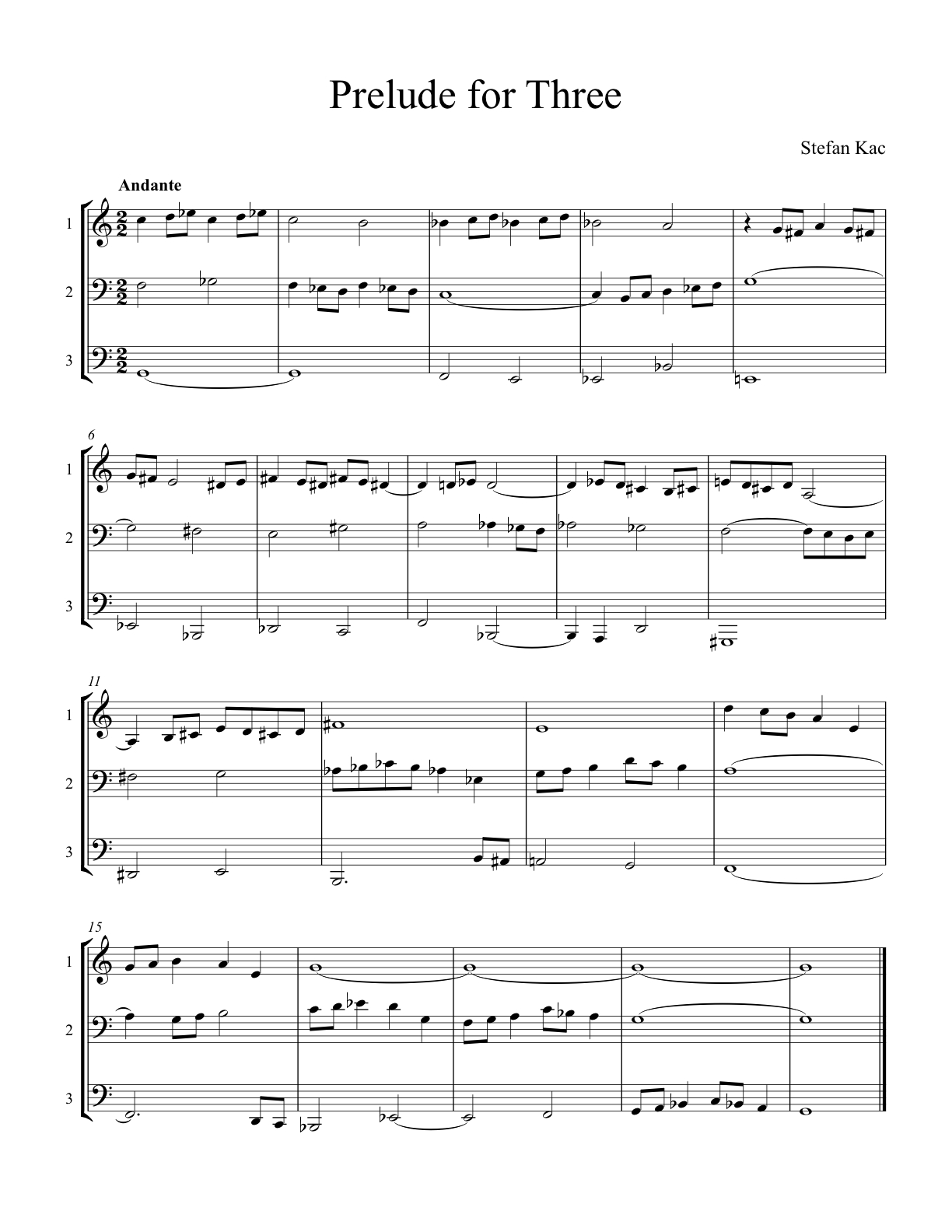
This is perhaps the only kind of music I can write pretty much on command, and when I'm in between projects and sit down to brainstorm for the next one, this is usually the first thing that comes out. I often keep the sketches but rarely ever end up using them; there isn't often enough material from which to build a substantial piece, and it's too damn pretty anyway. I've long maintained split musical personalities (classical/jazz, written/improvised, tonal/atonal) that operate in relative ignorance of each other at least as often as they cross-polinate, but it sometimes surprises me even so that I might produce something myself that would be, like this little trinket, likely to bore me to death if someone else had written it. I suppose that's why I've summarily tacked an ending on it and moved on rather than going for broke; and yet, there's definitely an attraction here, enough at least that I'm not completely ashamed to make it public when it could have, with less effort, been buried in the oblivion of my hard drive. Considering its brevity and the paucity of actual music that I post here, though, the oblivion of this blog seems the more appropriate one.
Though I folded in this instance, I increasingly find myself seeking to redeem such materials by subjecting them to "virtuosic" development, which represents an unlikely about face in some ways. In my younger days, I believed in an idea of "pure" inspiration whereby the very distinction between material and development was impossible to make. I still find this "improvising to paper" approach to suit my needs in many cases, but I certainly appreciate large-scale development more than I did previously. Here, I guess, is yet another of those balancing acts so typical of creative disciplines.
Finally, I wonder about potential practical uses for such neo-tonal miniatures. There is a dire need for educational music that introduces, for lack of a better way of putting it, "20th Century" musical content in a technically accessible way, and while there's nothing much here approximating what I would consider to be dissonance, the chromaticism would present interesting challenges (reading and hearing alike) to young players who have just learned their chromatic scales, as well as to more advanced players of transposing instruments who are learning to read in concert pitch. Finding K-12 educators interested in prioritizing these topics can be elusive, though, and so I'm not rushing to find a publisher.
Subscribe to:
Posts (Atom)

